The Frontier Vitality Index Is Corrected, Eleven Cities Change Places, El Paso Goes From Fourteenth To First, And El Paso Has Filed Against The Correction
El Paso spent three years ranked fourteenth in Texas for being near the border it is on. It is now first, the money moves in 2029, and the eligibility moves on Monday.
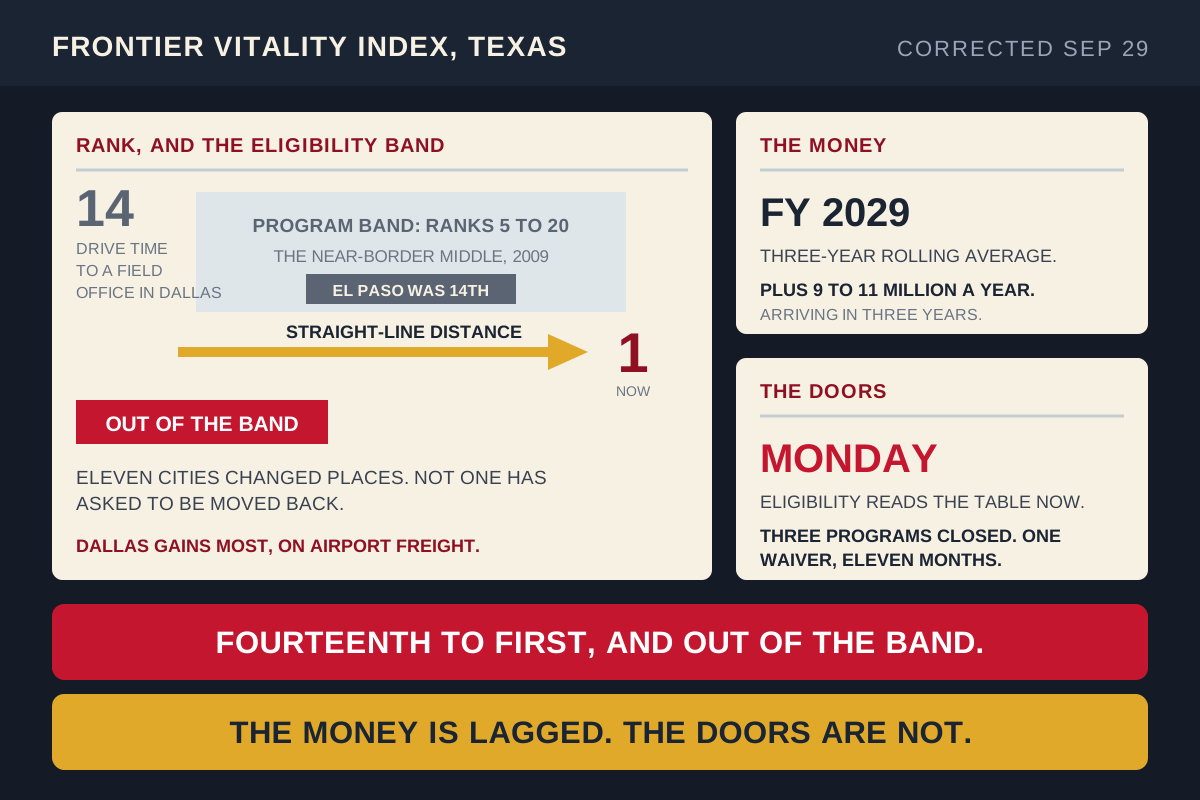
The Office of Regional Designation corrected the Frontier Vitality Index on the twenty-ninth of September. The variable this desk reported on in June, which measured border adjacency by drive time to the nearest field office and which put the nearest field office to El Paso in Dallas, has been replaced with a straight-line distance to the international boundary. It is the right fix. It is the fix this desk said in print was the obvious fix. Eleven cities change places, El Paso moves from fourteenth in Texas to first, and on Thursday the city of El Paso filed a formal objection to the correction.
This desk flew back down and spent two days establishing that the objection is not a misunderstanding, is not a negotiating position, and is not the work of anybody who thinks the old variable was correct. It is a nine-page brief, it concedes in its second sentence that the drive-time variable was wrong, and it asks for the correction to be stayed for three years. This column is about why, and the reason is not the reason this desk went down there expecting.
The Money Is Lagged And The Eligibility Is Not
The index does two things. It sets a formula share, which is money, and it sets program eligibility, which is doors. The formula share runs on a three-year rolling average, so El Paso's new rank starts affecting its money in fiscal 2029 and is worth, by the city's own estimate, between nine and eleven million dollars a year when it arrives. Eligibility does not roll. Eligibility reads the current table, and it read the new one at midnight on the twenty-ninth.
El Paso currently draws on four programs whose eligibility is written as a rank band: available to communities ranked fifth through twentieth on the Frontier Vitality Index. That band exists because the programs were designed in 2009 for what the drafters called the near-border middle, places close enough to the boundary to carry the costs and far enough from it to lack the dedicated appropriations that the top four get. El Paso was fourteenth. El Paso is now first. First is not in the band. Three of the four programs stopped accepting El Paso applications on Monday morning, and the fourth has a waiver process that the city has used and that takes eleven months.
So the correction takes nine to eleven million dollars away on Monday and gives nine to eleven million dollars back in 2029. The city's finance director showed this desk the two columns on one page and then said the sentence this desk has been turning over since: the error was costing us money for three years and the fix is costing us the same money for three years, and the only difference is that the error was somebody else's fault.
"We are not asking you to put the wrong number back. We are asking for the right number to arrive on the same clock as the money it moves. Three years. We will take first place in 2029 and we will take it gratefully." The nine-page brief, page two, first paragraph
The Brief Was Written By The Office That Asked Us To Hold The Story
This desk has to disclose something here. In June, a budget office asked this desk to hold the El Paso story for one cycle, and this desk declined, and said so at the time in a line most readers will not remember. That office wrote this brief. The same two people. This desk recognized the structure of the argument on page four before it reached the signature block, and then checked the signature block, and it was them.
They were not pleased to see this desk and they answered everything. Their position is that they asked for a hold in June because they already knew the variable was wrong, had already drafted the fix, and had already modelled the eligibility cliff, and what they wanted was one cycle to get a transition provision into the correction before the correction became politically impossible to delay. They lost that cycle. The correction went out clean, with no transition, in a four-paragraph notice, eight days after an article in this newspaper made the variable indefensible.
This desk put the obvious question, which is whether they are blaming the newspaper. The senior of the two said no, twice, unprompted, and then said the thing that is going in this column: you were right, you were right in June, you are right now, and the correction is worse for El Paso than the error was, and all three of those are true at once and none of them is your fault or mine.
The Argument That The Variable Was Never Wrong
Page six of the brief makes an argument this desk expected to be able to dismiss, and cannot. It is that the drive-time variable was never wrong, because the index never claimed to measure proximity to the border. The index's own 2009 methodology document, footnote fourteen, defines frontier adjacency as administrative access to federal border infrastructure, and a field office is federal border infrastructure, and El Paso's nearest one is in Dallas, which is a fact about El Paso that this desk verified in June and that remains true. On that definition the old number was a correct measurement of a thing nobody wanted to know, and the new number is a correct measurement of a thing the formula was never written around.
This desk spent an evening with the 2009 document trying to break that reading and could not break it. Footnote fourteen says what they say it says. The variable measured administrative access, it measured it accurately, and the reason it produced an absurd ranking is that the word in the index's title is frontier and the word in the footnote is administrative, and nobody between 2009 and this summer put the two words next to each other. It is right. This desk is printing that it is right, and noting that it has now twice been correct about this index in a way that made things worse for the city it was correct about.
Dallas Gains The Most, On A Different Variable
One more thing from the corrected table, because it is the only part of this that made anybody in El Paso laugh. Dallas does not drop to fourteenth. Dallas falls four places on border adjacency and rises nine on the index overall, because the recalculation re-weighted the remaining ten variables and Dallas is strong on the one that gained the most weight, which is airport freight tonnage. The city whose field office put El Paso fourteenth is the city that gains the most from El Paso being first. Not one of the eleven cities that changed places has asked to be moved back, and Dallas has not commented, and the brief does not mention Dallas, which the senior of the two authors said was deliberate and the best decision in the document.
Desk note: this desk's June position is unchanged and is now carrying an amendment. The position was that the national frame does not survive El Paso, and it did not: the index described a border city as the fourteenth most border-adjacent place in its own state for three years and no national account of the border noticed, and the people who noticed were a welder, a finance director and a footnote. The amendment is that a correction is also a frame, and this one arrived in four paragraphs with no transition provision and a Monday start date, and it was written by people who knew better and had been given eight days. The waiver on the fourth program is filed. The welding shop is still there, the roof is still the best vantage point in the county, and the welder's view of the correction, in full, is that it is nice to be first at something.