Politics
The Spine Desk Is Asked Whether A Membership Nobody Can Identify Is A Membership, And Rules That It Is
The equipment works. The desk checked the equipment first. The film shows a body no part of which can be named from inside it, and one vertebra at the top that can be named from outside.
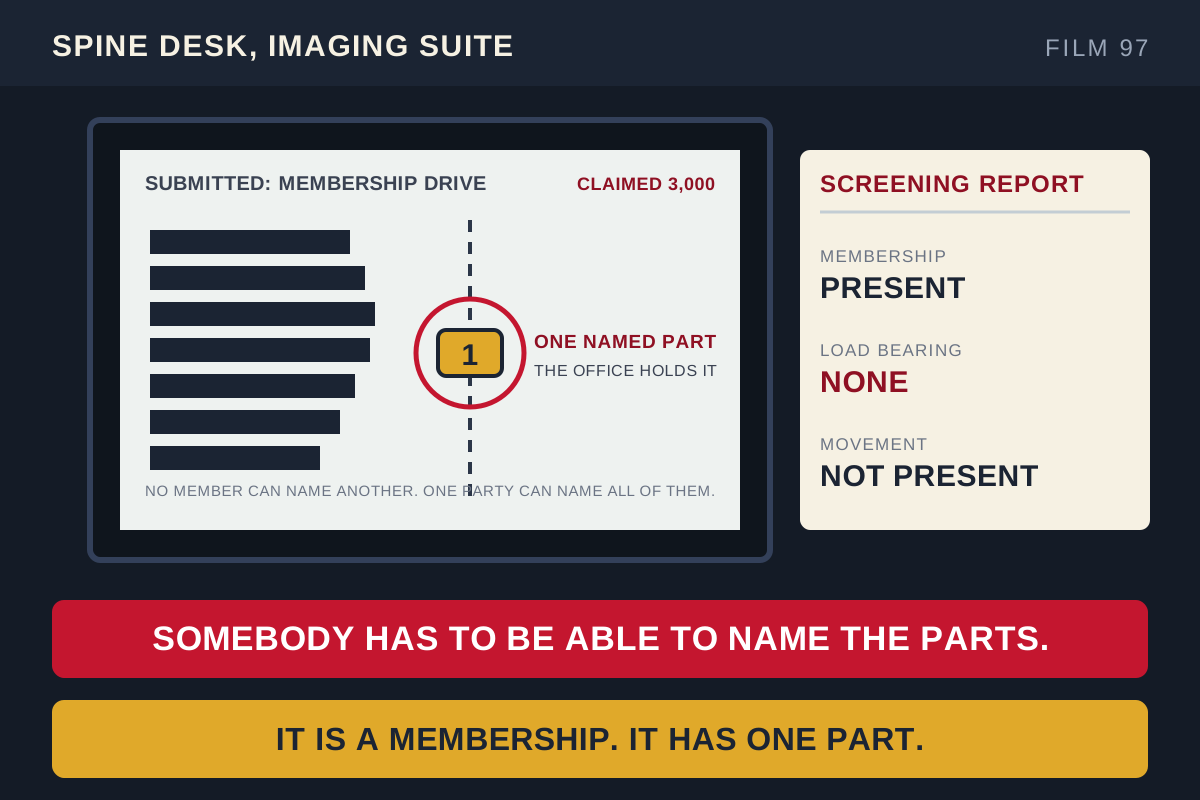
On the eleventh the extremism desk filed the recruitment form and closed its desk note on a question it could not answer: whether an organization that will not let its members know each other can be said to have a membership at all. It wrote that the question was going to this desk. It arrived on Tuesday, in writing, which means the first thing to report is that the equipment works. The desk checked the equipment first.
The Spine Desk screens courage by imaging the statements officials make about it, and its method is a load-bearing test: a statement carries a spine if it can support one proper noun without collapsing. The subject referred here is not a statement. It is a body, and the desk has a rule for bodies, inherited from the July muster and unchanged since: a body counts as a body when somebody can name the parts. Nothing in the referral asks the desk to change the rule. It asks whether the rule has anything to bite on.
What Was On The Film
The intake produces no field in which a member can be named. No name, no date of birth, no employer, no reference, no previous affiliation and no photograph, which the extremism desk published on the eleventh, so the desk put the organization's own rendering of itself on the film: the claimed three thousand as the form represents them, which is a stack of identical bars with no part distinguishable from any other part. That is not a compositional choice. It is the resolution the intake system provides.
There is one exception on the film and it is at the bottom of the form, where a single field is marked required. The uniform has to arrive somewhere, and the desk established in September that it does not arrive at a post office box, because the form says so in the only sentence on it that carries a rule. So the parts of this body can be named, all three thousand of them, by one party, and it is the office that posted the uniform.
"The film shows a body. I cannot examine it part by part, because no part of it can be identified by any other part, and that is not the same as absent. A jar is not a specimen. It is what a specimen is kept in, and one party has the key." June Hardaway, imaging suite
The Ruling
It is a membership. The desk rules that an organization whose members cannot identify each other has a membership, and the ground is the desk's own rule rather than a concession to the organization: the test asks whether somebody can name the parts, and somebody can. Anonymity is not the absence of a roster. It is a roster held by one party, which is an ordinary property of a mailing list and an unusual one for a movement. The extremism desk's figures are untouched by this ruling and are restated here in the register's usual order. Three thousand claimed. Three hundred and eighty counted at the largest muster of the quarter, over four hours, from a fixed position, twice, the two runs differing by one. Two hundred and nineteen tickets issued by a municipal machine that counts vehicles and not people. The register reconciles none of the three, as it has not since 2022.
Why The Film Shows One Vertebra And Not Three Thousand
The index measures load and not motive, and load has a direction. A part is load-bearing when another part can put weight on it. No member of this organization can put weight on any other member, because no member can find one, and the only part of the body against which any weight can be brought to bear is the office that holds the addresses. A subpoena, a process server, an invoice from the vendor who posted the uniforms or an ordinary data breach would each reach all three thousand without a single member knowing anything about any other. Three thousand parts, one of them load-bearing, and it is the one that is not anonymous to itself.
The desk declines, on the record, to call it a movement. A movement is a body that can bear load in more than one place, and this one carries its whole load through a single vertebra at the top, which is the clinical description of a spine that cannot bend. The quarterly rescan has spent two screening cycles finding cartilage that arrived with the polling and calling it bone. This is the first film the desk has put in the cabinet on which the bone is real, and it records that it found it in the last place it looked, which was the office.
Clinical note: the film is drying on the lightbox and will be filed as film 97, which makes it the fourth in the reference cabinet, and the desk says for the second time that a cabinet of four films is not a spine bank. The binoculars came back on Tuesday with the strap on backwards and a receipt inside the case for something the desk did not buy, and the desk has stopped asking. The one question this ruling leaves open is the one the office is better placed to answer than the desk is, which is how many people it can actually name, and the desk has written to ask for the figure. It has never been given a number by a party that had one, and it is aware that wanting the figure is not the same as being entitled to it.