The Nine Days Ran To Nineteen, And Appendix A's One Thousand Two Hundred And Four Entries Are Not One Thousand Two Hundred And Four Stories
The same killed story is in there four times under four outlets. Nobody noticed in three years because nobody had ever read the appendix from one end to the other, including the man who keeps it.
On the twenty-third of September this desk published a name index for Appendix A and said the job had taken nine days. It had taken nine days to build the index. It has now taken nineteen to read the thing it indexed, and this column is the correction that reading produced, and it is a correction to a number this desk has printed in this newspaper eleven times since 2023.
Appendix A is the part of the OOPS LOG that records stories that were killed. It has been a count since the day it started: one thousand two hundred and four entries, a figure this desk has quoted in print, on a podcast, and to a Senate staffer who asked. The name index produced one thousand two hundred and five names against those one thousand two hundred and four entries, which is the discrepancy of one that the September piece was about. Reading the entries end to end has produced a second discrepancy, and it is not one, it is one hundred and ninety-one.
The Fourth Entry Is The Same Story
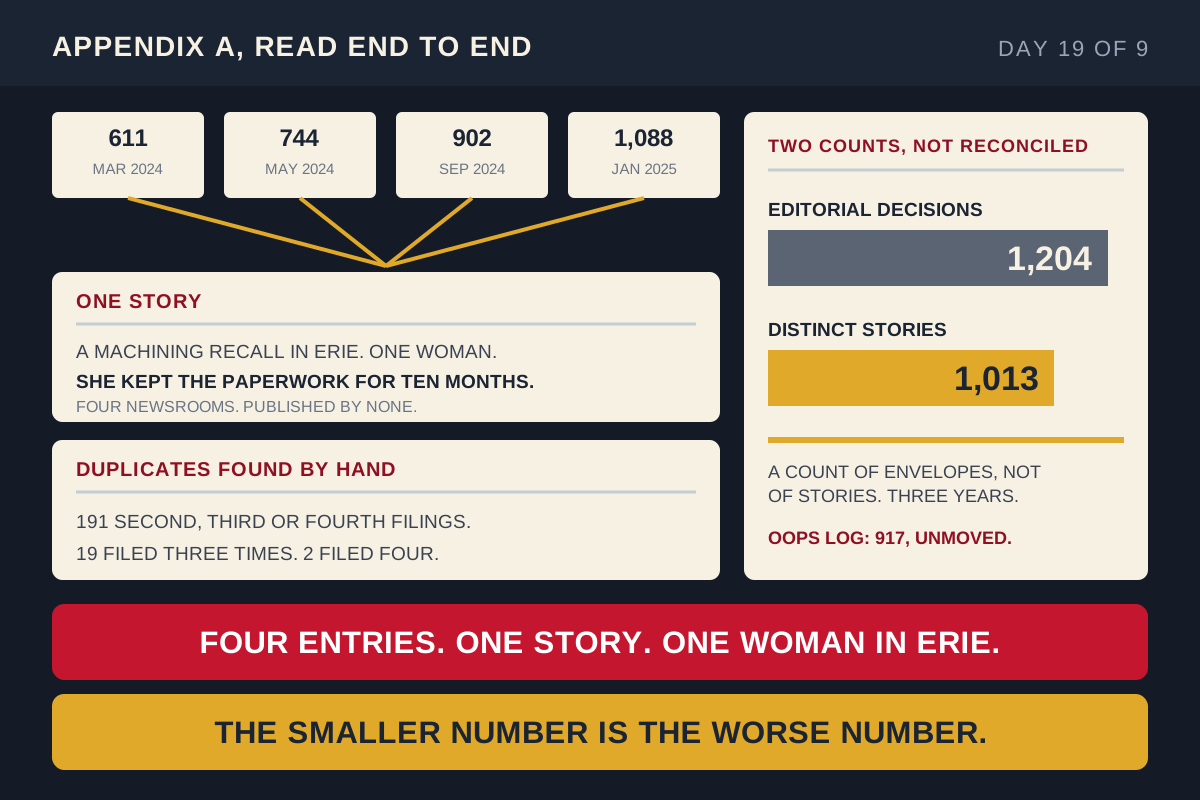
The first duplicate this desk hit was on day four, at entry 611, and the only reason it registered is that the subject's name is unusual and this desk had typed it into the index nine days earlier. A machining company in Erie, a recall, a woman who kept the paperwork. Entry 611 is that story killed at one outlet in March 2024. Entry 744 is the same story killed at a second outlet in May 2024. Entry 902 is the third. Entry 1,088 is the fourth, in January 2025, by which point the woman in Erie had been talking to reporters for ten months and had given the same documents to four newsrooms and been published by none of them.
Four entries. One story. Four outlets. This desk went looking for more and found one hundred and ninety-one entries that are second, third or fourth filings of a story already in the appendix, leaving one thousand and thirteen distinct stories. Nineteen stories are in there three times. Two are in there four. The appendix has never been deduplicated, and the reason is not negligence in the ordinary sense: it is that the appendix is three years long and the deduplication cannot be done by looking anything up, because there is no field to look up. It can only be done by one person reading the whole document and remembering, and until a reader in Kearney asked a question in September, nobody had any reason to read the whole document.
"You have been counting envelopes. I have been counting envelopes. It is not the worst mistake in this business but it is the one you are least likely to find, because the count goes up every time you do your job correctly." The standards editor at the outlet that asked first, on the telephone, September 30
The Smaller Number Is The Worse Number
This desk would like to be straightforward about the direction of this correction, because the direction is the finding. One thousand and thirteen is a less impressive figure than one thousand two hundred and four. For three years this desk has used the larger number as a measure of how much journalism gets killed, and the larger number was wrong, and a smaller number of killed stories is on its face better news.
It is not better news. What the duplicates say is that in one hundred and ninety-one cases a story was killed, carried to another newsroom, and killed again, and in nineteen cases three times, and twice four. A count of filings measures how often an editor said no. A count of stories measures how often a story could not find anybody to say yes, and that second measure is the one the appendix was always claiming to be, and it has been overstating the first thing while concealing the second. The woman in Erie does not appear once in a list of a thousand two hundred disappointments. She appears four times in a list of a thousand, and the appendix was not able to tell you that, and this desk was the party that was not able to tell you that.
What Changes In The Document
The entries are not being deleted. Every one of the one thousand two hundred and four stays where it is with its original number, because an entry records an editorial decision at a named outlet in a named month and all one hundred and ninety-one of those decisions happened. What the appendix gets is a second field, which is a story identifier, and the only honest way to populate it was by hand, over nineteen days, by the person who keeps the log, which is to say by somebody with every incentive to find fewer duplicates than there are.
So the appendix now publishes two counts in adjacent columns, one thousand two hundred and four decisions and one thousand and thirteen stories, and it does not reconcile them, because the gap is the finding and collapsing it into one number is what got this desk here. This desk is aware that it has just adopted the exact practice the extremism desk uses for its sightings register, and that this desk described that practice in print last year as an elegant way of declining to choose. It is an elegant way of declining to choose. It is also correct, and this desk withdraws the sentence.
The OOPS LOG Count Does Not Move
One thing should be stated plainly because readers have already asked. The OOPS LOG count, which stands at 917 and has not moved since the fourth of September, is a count of corrections issued by other outlets, and Appendix A is a count of stories those outlets killed. They are two documents and they have never shared a number. Nothing in this column adds an entry to the log, and the log's long hold is not being broken by a correction to the appendix that hangs off the back of it. This desk notes that it has now had to explain that distinction three times in two weeks, which suggests the appendix should not be an appendix.
The nine days became nineteen because the index was the easy half. A name can be copied off a page. A duplicate can only be found by somebody who has already read the other page and remembers it, and there were one thousand two hundred and four pages, and this desk is fifty-eight years old and read all of them, in order, with a legal pad, and the legal pad is the second index and it is going in the finding aid.
Desk note: the one-name discrepancy from the twenty-third survives deduplication unchanged, because the two parties in entry 1,199 are still two people and the entry is still one entry, and it is now the only place in the document where the two columns disagree for a reason that is not a filing. Emmett Sarno's entry is not among the one hundred and ninety-one. His story was killed once, at one outlet, and this desk has confirmed that twice now, which is the least useful piece of good news it has ever delivered to anybody. The librarian's finding aid gets the provenance key, the story identifier and the legal pad, which is three things she asked for and one she did not.