The Man Who Played The Fiddle Reads Our Correction And Asks For A Second One, Because We Have Now Described Him Three Times Entirely By Things He Did Not Do
No tune repeated. Six offers refused. Name withheld. Not paid. Four facts, all checked, and not one of them is about music.
On the fifth of September this desk published the one story a sports reporter is qualified to file about a musician, which was the stat line: three hours of playing at a reassigned gate, no tune repeated, six offers of payment refused, and the name left out at his request. He had cleared one line for print and it was a correction of us, and we ran it. On the twenty-eighth he wrote again. He has read the correction. He would like a second one, and the second one is not about a fact.
His letter is four sentences long and this desk has read it maybe thirty times. It says that this newspaper has now described him on three occasions, in September, in the correction, and in a ticker line he did not see but was told about, and that all three descriptions are made out of things he did not do. He did not repeat a tune. He did not accept money. He did not give his name. He was not paid. He writes that he is sure every word of it is accurate and that he does not recognize the person in it, and that a man who is described four times by absences starts to sound like an absence.
The Desk Tried To Write The Other Description
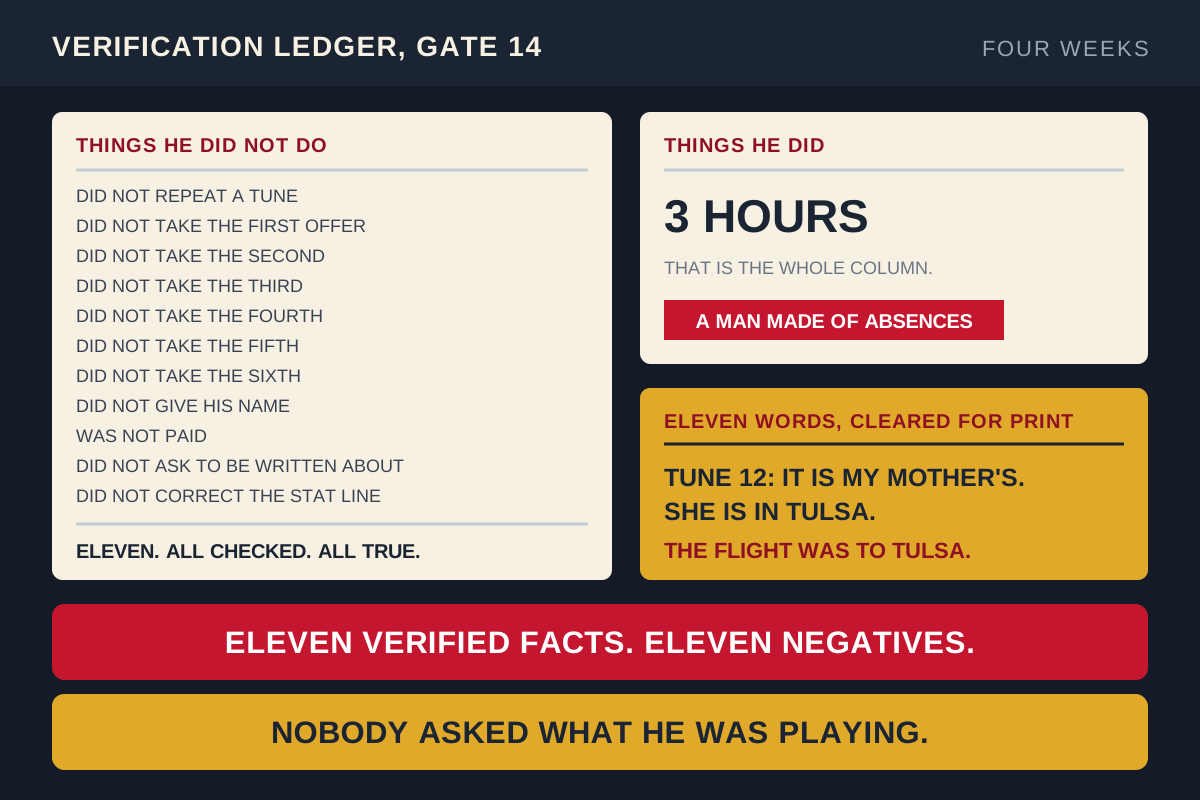
This desk's first instinct was that he was wrong and that the file was full of positive facts. So this desk went back through the file, which is a notebook, two voice memos, a gate agent's statement and the original seven paragraphs, and sorted every verified fact into things he did and things he did not do. The second column has eleven entries. The first column has one. The one is three hours.
That is not a reporting failure in the ordinary sense. Every negative in that column is there because this desk checked something and the check came back no, and a check that comes back no is a verified fact and belongs in the story. No tune repeated is a real finding and it took two voice memos and a man in Nashville to establish. Six offers refused is a real finding and the gate agent counted them independently. But a story built only out of confirmed negatives is a story about the checking, and this desk has filed it twice now under the impression that it was a story about a musician.
"You have written down everything I would not do. I would not have minded if you had asked what I was playing. Nobody asked what I was playing. The gate agent asked. She is the only one who asked." The fiddle player, in the letter, third sentence
Nobody Asked What He Was Playing
This desk went back to the voice memos with a specific question for the first time, which is embarrassing to put in print and is the point of this column. Three hours of recording. Nineteen tunes identifiable to anybody who knows the repertoire, which this desk does not, so this desk sent both memos to a man in Nashville who does, and he had them back in a day with nineteen names, a note that the third and the eleventh are the same tune in two keys and whether that counts as a repeat is a question for the desk and not for him, and the observation that the set has a shape.
The shape is this. The first eleven are standards, the kind you play at an airport when nobody has asked you to play. The twelfth is not a standard. From the twelfth on he is playing one tune in nine variations and the ninth variation runs eleven minutes, which is the longest continuous passage in the three hours and comes forty minutes after the gate reassignment was announced, which is to say after the moment the crowd he was playing to stopped being a crowd of people leaving and became a crowd of people staying.
This desk wrote to him and asked one question. Not his name, not the money, not the refusals. What is the twelfth tune. He answered in eleven words and cleared them for print, and this is the first thing in five weeks of filing that he has volunteered rather than corrected.
"It is my mother's. She is in Tulsa. The flight was to Tulsa." The fiddle player, cleared for print, October 2
The Correction
So the correction he asked for is issued and it is in the body of this story rather than at the foot of it, because it is not a factual correction and the corrections column is for facts. Nothing this newspaper printed about him was false. What was wrong is that this desk conducted a four-week verification of a man and never once asked him about the thing he was doing, and then described him three times by its own negative results, and the description was accurate and it was a description of this desk's work and not of him.
He is a fiddle player who played for three hours at a gate in an airport, nineteen tunes, eleven of them standards and eight of them one tune his mother plays, worked outward over an hour and a half, the last pass eleven minutes long, for a room full of people who had just been told they were not going anywhere, on the night of a flight to the city his mother lives in. That is the story. It was available on the fifth of September in the second voice memo, forty minutes in, and this desk had the memo and sent it to a stringer for a tune count.
Desk note: the third and eleventh tunes are the same tune in two keys and this desk is ruling that it is not a repeat, which revises the September stat line from no tune repeated to no tune repeated, with one played twice in different keys, and that revision is the only part of this that belongs in a stat line. His name is still withheld and he has not been asked for it again. The six refused offers stand at six. This desk notes for the record that it has spent a month establishing with great care that a man would not take money, and eleven words establishing what he was playing, and that the ratio of effort to information in those two inquiries is the worst this desk has ever published and is going on the wall.