White House Review Finds The Press Secretary Is Licensed To Answer The Question Of Whether She Is Licensed
The public file contains a question about a bar record, a defense that the question is a misunderstanding and a complaint asking California to investigate. The review board found the only credential the office can establish is the authority to keep the question open.
Reports this week asked whether Katie Zacharia, the White House's new press secretary, is a lawyer. The White House defended her. Zacharia told The New York Times that the confusion over her legal credentials was the result of one big misunderstanding. A complaint asking the California bar to investigate followed. This desk approached the file expecting to find a question about a credential and found instead a question about the kind of question a credential can be.
In Washington, a credential is treated as a small paper that settles a large question. The bureau's review found no binder for the question. It found three for licensing, two for public office and one for people who answer questions about licensing.
The Form Was Not Designed For A Noun Alone
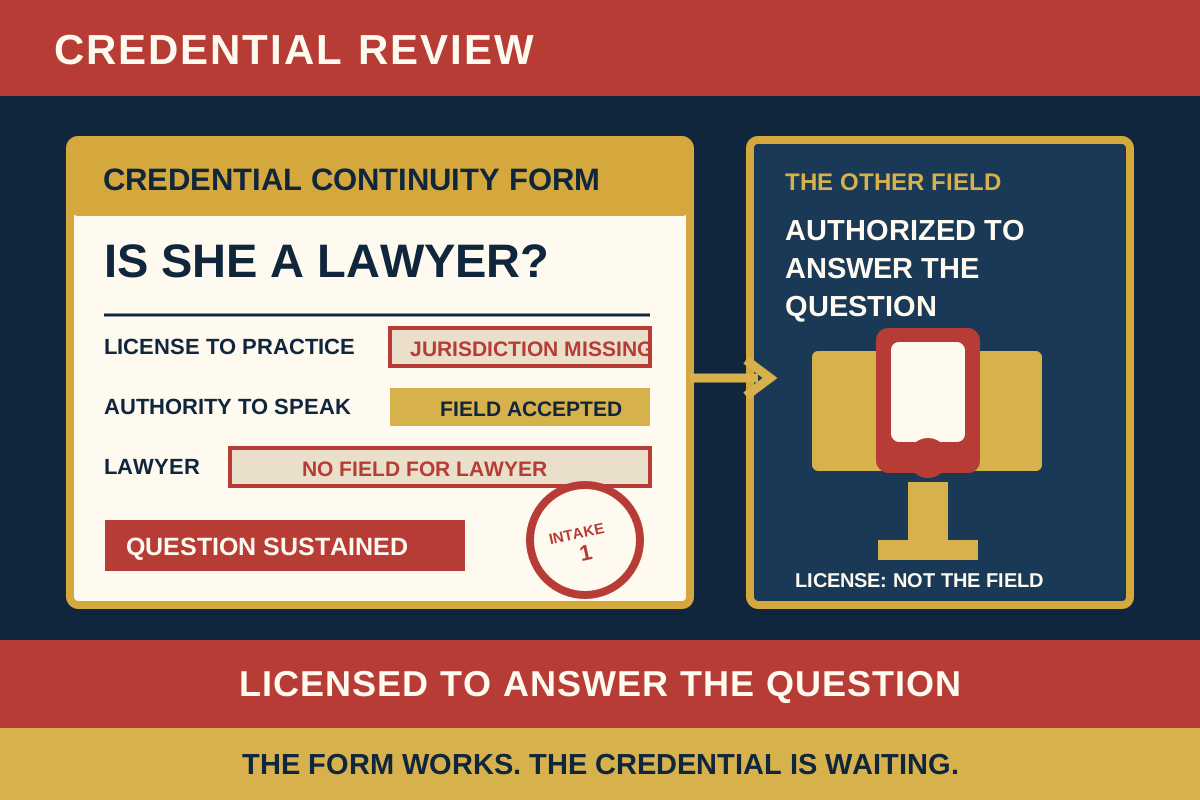
The National Office of Professional Standing maintains the Credential Continuity Form. Its first field asks whether the subject is licensed to practice. Its second asks whether the subject is authorized to speak for an office. Its third asks which jurisdiction supplies the answer. The form has no field labeled lawyer, which the registrar said was deliberate.
"Lawyer is a useful word in conversation and a poor field in a database. It can describe a license, a job, a degree, a habit of answering, or the fact that somebody has been asked to explain the word lawyer. We accept four of those and refer the fifth to counsel." Eleanor Voss, registrar at the National Office of Professional Standing, Thursday
When the desk entered the question as written, the form returned it twice. The first return said jurisdiction missing. The second said practice status missing. The third page, normally used for appeals, filed the same question under Question Sustained. Nobody had answered it. It had merely been entered correctly.
The Complaint Gave The Question Standing
The complaint to California's bar changed the file without deciding it. Before the filing, the question existed in reports, a defense and a sentence from Zacharia about misunderstanding. After the filing, it had a receiving body, an intake number and a place to wait. The docket clerk calls this jurisdictional improvement. The credential remained elsewhere, if it existed, and the docket was not permitted to speculate.
"A complaint is not a finding. It is a way of telling a finding where to sit if one eventually arrives. Our system does not confuse a chair with a person." Marvin Pell, intake clerk at the California Credential Docket, Thursday
This was the point at which the desk expected the administration's defense to fail. The defense had said the confusion was a misunderstanding, and the desk had understood that as a claim about the answer. The form showed it was a claim about the question. There is a difference between not knowing whether a person has a license and not knowing whether the word lawyer is being used to ask about a license. The first is unresolved. The second is already documented.
The Press Office Passed The Test It Was Given
The review board then ran the office through a test it designed for spokespeople, not attorneys. It sent twenty-seven questions about legal status, pending complaints and the meaning of admitted. It did not ask Zacharia to practice law or offer legal advice. It asked whether a question could be routed to the right office without being answered by the wrong one. Twenty-six arrived at the correct desk. The twenty-seventh was returned because the sender had checked both license and authority to speak and the form will accept only one.
"The White House does not need a lawyer at the microphone in order to have a position on lawyers. It needs somebody who can tell the difference between an answer and a request for one. We have not found a bar for that. We have found a desk." A deputy registrar at the National Office of Professional Standing, Thursday
A Conclusion Worth Filing
This desk set out to determine whether the credential question exposed a weakness in the administration's defense. The record supports a narrower finding. The reports raise a question about Zacharia's legal credentials. Her statement calls the confusion a misunderstanding. The California complaint gives the question a path to an answer. None of those three things is the answer, and none is allowed to impersonate one.
That is not a vindication of a license. It is a finding about jurisdiction, which is the kind of finding that survives because it refuses to take possession of the fact it was sent to retrieve. In 2016 this desk would have expected a Washington office to turn a credential dispute into a larger argument about character. The current file has done something more modest and, on the evidence, more competent: it separated a license from the person who asks about it, a complaint from a ruling and a microphone from a bar.
The distinction does not settle whether Zacharia is a lawyer. It settles that the press office can discuss the question without manufacturing an answer, a lower standard than the bureau expected to report and a higher one than the first headlines suggested. The desk will keep the credential field blank until a jurisdiction fills it. The form works.
Editor's note: Gerald Worthington III has reviewed the form, the complaint docket and the bureau's 2016 file. The bureau's conclusion is that a question can be properly filed before it can be properly answered, which is not a position this desk would have endorsed in 2016 and is, on examination, the position this desk is now filing.