Business
The Accounts Mature In 2043, And Every Recipient Will Meet The Donor's Name In A History Unit Rather Than On A Statement
Eleven programs in this file collect their gratitude inside one quarter. This one collects none for eighteen years, and the year it does collect is already printed in a curriculum.
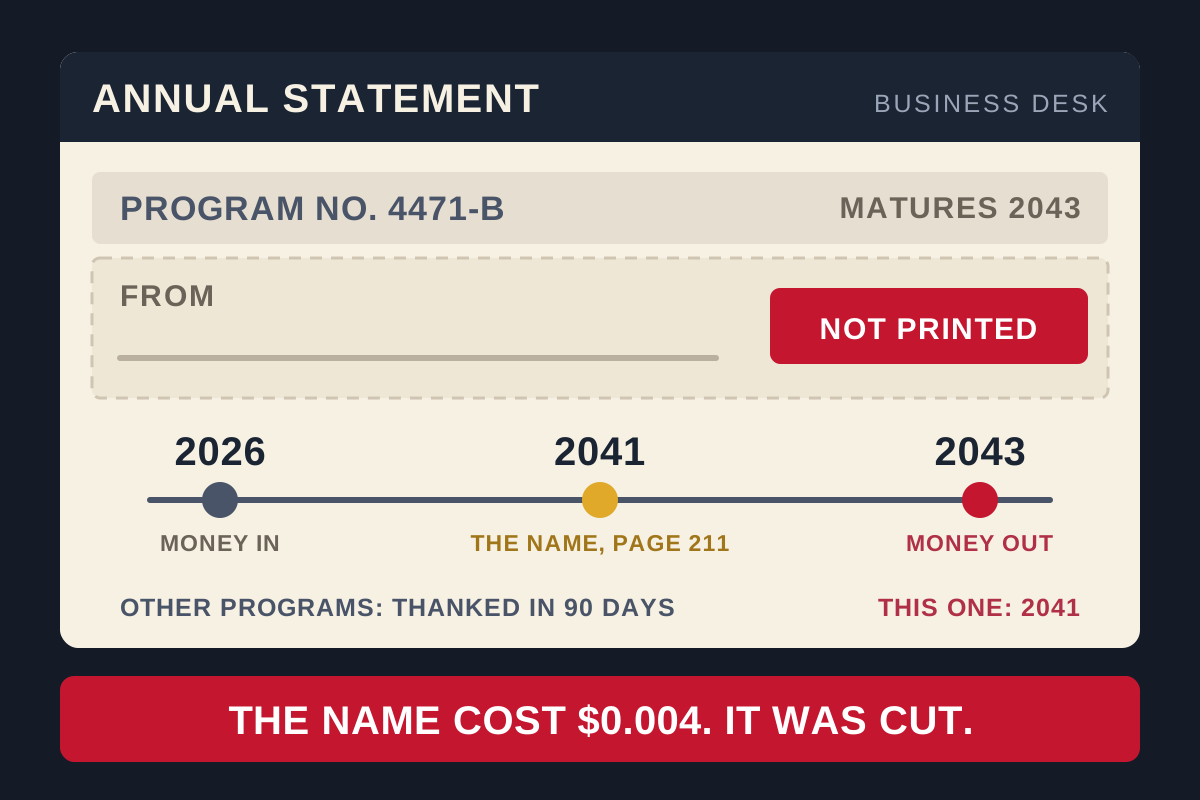
The birth-account program seeds one account per child at birth, once, and locks it until the holder turns eighteen. The first cohort matures in 2043. It is the largest single appropriation announced in the Atlanta speech on July 22, and this desk went back to the transcript to find it, because it had not covered it and neither had anybody else.
It is eleven seconds long. It sits between a remark about an airport and a remark about a fiddle. The data desk clocked that speech at nine topics per minute, and at nine topics per minute the biggest number in the room gets eleven seconds and no follow-up question, which is not a failure of the speech. It is what nine topics per minute is for.
The Curve That Is Flat For Eighteen Years
This desk keeps a schedule for eleven federal benefit programs of comparable size, because the pattern is reliable enough to be boring: a benefit is announced, the first payment lands, and the letters arrive inside one quarter. Every one of the eleven collects its gratitude within ninety days of the first disbursement. The curve is the same shape eleven times.
This one is flat for eighteen years. The account is funded once, at birth, by a party the recipient has no way of identifying, and the statement that arrives every January carries a program number, a balance, a maturity date and nothing else. There is no name anywhere on it. This desk has now read four consecutive annual statements and can report that the document does not indicate that a person was involved.
That is a design nobody in this file has ever chosen. A benefit collects its thanks. It is the reason a benefit is announced from a podium rather than filed, and eleven curves in this desk's own spreadsheet say so without ambiguity. Here the thanks cannot arrive at all until the recipient is old enough to learn, from somewhere other than the statement, that there was somebody to thank.
It Is Not Modesty. It Is Four Tenths Of A Cent.
This desk assumed modesty, wrote two paragraphs on modesty, and then did the thing it is paid to do, which is to ask for the costing.
The naming line was struck at the print-specification stage. Adding it would have taken the statement over the single-panel threshold and into a second panel, which prices at four tenths of a cent per statement across 3.6 million statements a year. Fourteen thousand four hundred dollars annually. The memo is one page, it is dull, it does not mention the President, and it is the entire explanation.
"It was a panel question. We were under on panels and over on paper. Nobody at that meeting was thinking about whose name it was." A program officer who asked to be described by her function
So the only federal benefit in this file that cannot be thanked was built that way by a printer's estimate, and this desk would like to record that it preferred its own first explanation and had it in the copy for two hours. The memo is better sourced. The memo runs.
The Gratitude Is Already Scheduled, By People Who Do Not Take Calls From This Desk
The thanks do arrive. They simply arrive from a classroom, and a classroom is a state decision, so this desk spent Wednesday calling state boards of education, which it has never once had to do for a business story.
Forty-one states have already adopted the unit that carries the program. Twenty-six of them place it in the eleventh grade, which puts the donor's name in front of the recipient at sixteen or seventeen, two years before the money. Fifteen place it in the twelfth, which puts the name in front of the recipient after the account has matured and, in most cases, after it has been spent. The split is 26 to 15 and it was settled in adoption cycles that closed this spring, for a unit that will first be taught in 2041.
This desk has spent nine years asking institutions what they intend to do and when. It has been told that the path is data dependent, that the committee will assess conditions as they evolve, and on one occasion that guidance itself had been withdrawn as a category. On Wednesday a textbook adoption officer in a state this desk will not name gave it a year, a grade, a page count and a revision cycle, unprompted, in under four minutes, and asked whether that was the level of detail required.
"It is on the 2041 list. Page two hundred and eleven. We do not move those." A state textbook adoption officer, Wednesday
That is firmer forward guidance than this desk has ever obtained from a central bank, and this desk wishes to be clear that it is not making a joke at the expense of the state board. The state board answered the question. It is the only body in this article that did.
The Row That Carries No Figure
There is no observable until 2041, and nothing is settled until 2043. Every number above is a schedule rather than a result: the 26 and the 15 are adoption votes, the 3.6 million is a print run, and the maturity date is arithmetic performed on a birth certificate. Not one of them has been tested against anything.
A projection at a seventeen-year horizon with no interim observable is not a forecast. It is a bet, and Column F of this desk's Sunday file exists because of people who published bets as forecasts and were quoted as current for a median of forty-one days afterwards. So the row is open in the file and it carries no figure. It carries a date and a blank cell, and the cell stays blank until somebody can check it.
Desk note: this desk will be sixty-nine in 2043, which it mentions only because a reader wrote in March to ask why the Sunday file has no rows beyond a five-year horizon, and the honest answer was that this desk had never opened one. It has now opened one. It contains a date, a blank cell and the name of a program whose recipients are currently between nought and three years old and are the only people who will ever be able to say whether any of this was worth fourteen thousand four hundred dollars a year in panels.