The Sanctions Waiver Took Effect Before The Sanctions Did, And The Price Desk Found A Number For Not Paying
The bill had not been issued, the barrel had not moved, and the risk column fell from eighteen cents to two after the waiver. The desk's problem was finding out what the other sixteen had been buying.
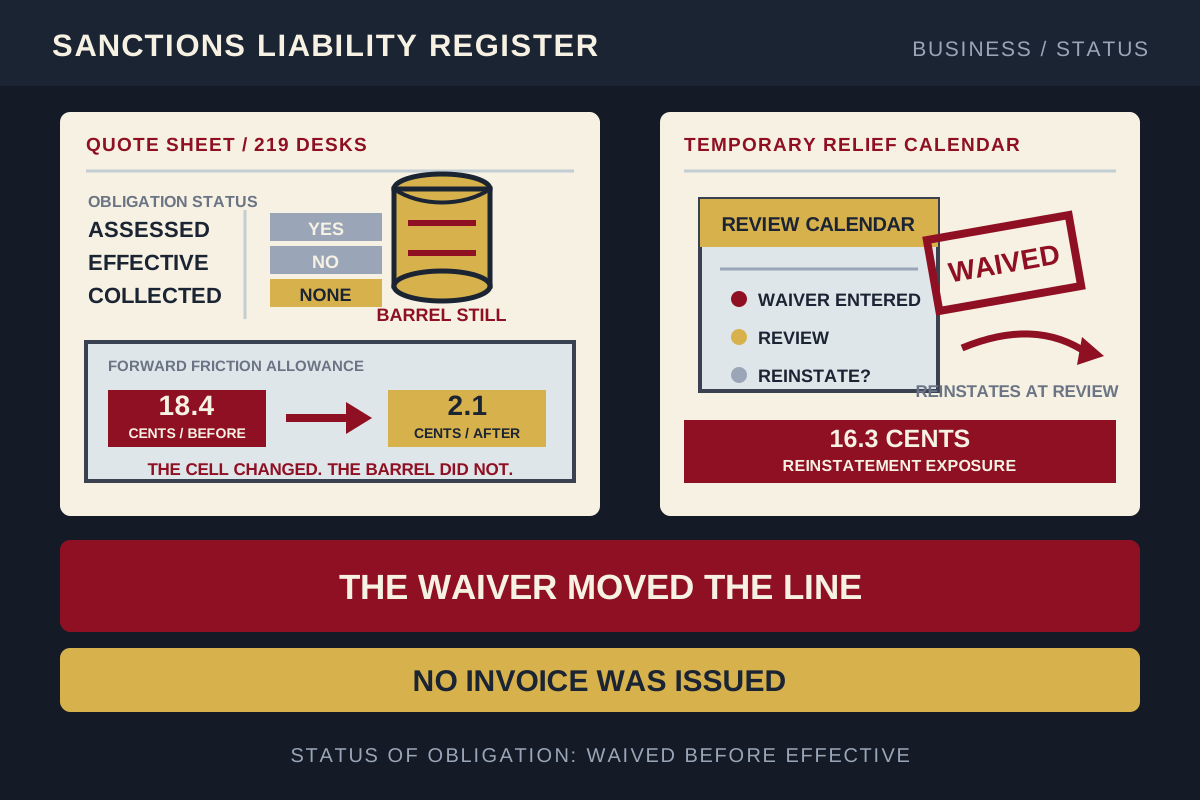
The reported action was a pause: new sanctions on Russia and tariffs on large-scale buyers of Russian oil did not take effect late Friday, with the stated aim of easing prices by tapping Russian energy. That is the event. This desk was assigned the narrower question the event leaves behind: what is the price of a charge that was never collected? The answer is in the Sanctions Liability Register, which is not a government record, has no authority over a barrel and nevertheless has 412 columns.
The Charge Was In The Form, Not The Barrel
On Thursday the register had three fields for each of 219 import desks: assessed, effective and collected. No importer had paid, no shipment had been stopped and no tariff invoice existed. The form still carried a Forward Friction Allowance, a number for the possibility that a charge might arrive. It averaged 18.4 cents a barrel. After the waiver entered, the allowance fell to 2.1 cents. No cargo moved. A cell changed from may be charged to waived, and the quote sheets treated the change as information.
"I had no invoice to remove. I had a line for the invoice I expected, which is different in the accounts and identical in the price until the line changes." A risk clerk at the North American Sanctions Settlement Panel, by telephone, Saturday
The Zero Needed A Date
The desk's first finding was that a zero is not a conclusion when the field is temporary. The Temporary Relief Calendar has four entries: expires, reinstates, extended and unknown. Unknown was removed in 2024 because it encouraged clerks to stop reading. The Friday entry says reinstates at review, which is not a date but is an instruction to expect one. Of 61 files opened Saturday, 58 quote sheets lowered the friction line and three did not. The three had no field for a waiver. A blank did not mean no risk. It meant nobody had written a noun.
The remaining 16.3 cents did not price Russian oil: the physical replacement line on all 61 files was unchanged. It priced the possibility that the charge would return when the calendar was read again. The panel calls this reinstatement exposure, the first number in the file reduced by a waiver and preserved by its temporary status at the same time.
"A permanent zero is a price. A temporary zero is a question with a calendar attached, and we do not clear questions through customs." The registrar of the Temporary Relief Calendar, in a written response, Saturday
The Desk Lost The Second Column
Douglas Merritt opened sunday.xlsx, the saddest spreadsheet in the building, and found the error in his own file. Every row had a charge column and a delivery column. None had a status-of-obligation column. In 38 earlier cases where a fee was withdrawn before its effective date, the desk coded the fee as zero. That made a non-event look like a costless event. Zero says a charge existed and was not paid; waived-before-effective says the charge never became payable. The desk had put both in one cell for seven years.
Column I now carries the status. The Friday row is the first marked waived before effective, and the revision changes no barrel, delivery date or replacement quote. It changes why the risk line moved. This desk set out to show that a waiver of an unapplied charge could not have economic content. It can show that the waiver did not add physical supply. It cannot show that a quote sheet was indifferent to a bill and a blank.
The Price Was For The Sentence
The control group was 41 non-oil import files carrying a possible levy but no sanction timetable. Their physical replacement lines did not move on Saturday. Their friction lines did not move either, because a risk without an effective date is a note and not a number. The waiver supplied the date-shaped event the other files lacked. It did not make the barrel cheaper. It made the liability legible enough to remove and the return legible enough to retain.
"We did not receive oil. We received a field that tells us whether it can arrive under the same rule next week, which is less merchandise than a price desk wants and more than a blank gives us." A settlement analyst on the desk's panel, Saturday
The desk's standard reference remains Federal Reserve Bank of Dallas Working Paper 23-09, which it uses for the proposition that a quoted risk can move before delivery. It cited the paper Friday and applied it Saturday, when the waiver made the risk column readable. Row 1,313 enters the Sunday file with 18.4 cents in the old field, 2.1 in the reinstatement field and a correction to the desk's category, not the arithmetic. The charge was never collected. Its possibility had been earning a place in the price anyway.
Desk note: the 2026-10-17 row is not a measure of Russian oil's price. It records how 61 fictional quote sheets classified an obligation after the waiver. Column F marks the old prediction wrong, Column I records why, and the desk will not combine them because the spreadsheet has room.