The Committee Is Told The Donor's Name Costs One And A Tenth Cents A Statement, And Seven Tenths Of That Is A Charge The Program Pays Once
Four tenths of a cent was the July figure and it has not moved. The committee has been given one and a tenth, and the whole of the difference is a charge paid once and divided by a run that prints every January.
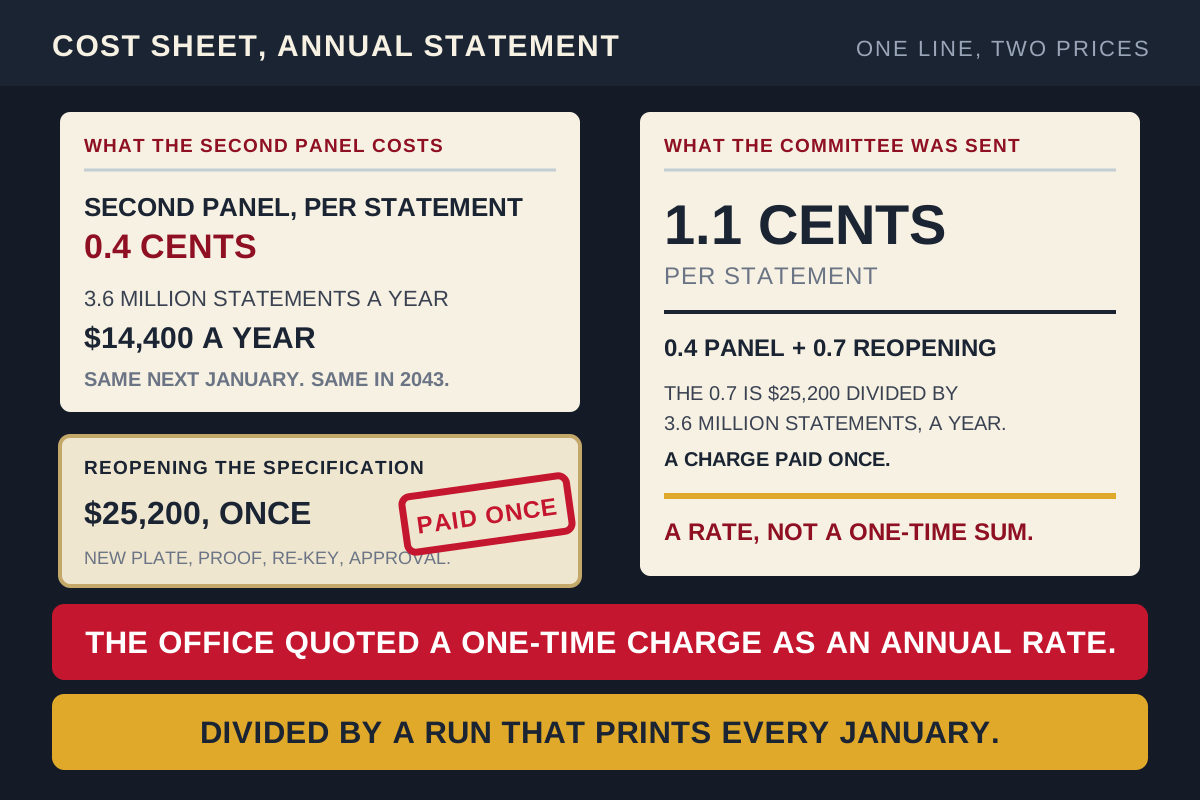
The print specification for the annual statement was reopened on Monday, and the figure that came back is one and a tenth cents a statement. In July the same line was priced at four tenths. This desk reported that four tenths in September, when it found the naming line had been cut to hold the statement to one panel, and it is the reason the committee asked for a fresh figure rather than the old one. The office sent the worksheet the same afternoon, which is the second time in this file that a party has handed over the part that does not help it.
The Panel Costs Four Tenths And Always Has
The statement is held to one panel, and a panel is not a paragraph. Putting the donor's name back requires a second panel, and a second panel is priced against a form. In July the office priced it at four tenths of a cent across 3.6 million statements, which is fourteen thousand four hundred dollars a year. That figure has not moved. The second panel costs four tenths this January, it will cost four tenths next January, and it will cost four tenths in 2043, because the form is set once and the panel is on it.
The Other Seven Tenths Is Paid Once
The difference between one and a tenth and four tenths is seven tenths, and this is what those are. Reopening a specification that was closed in October is a fixed charge - a new plate, a proof, a re-keying and an approval cycle that starts again from the first page - and the office quotes it at twenty-five thousand two hundred dollars. It is paid once. Divided by 3.6 million, it is seven tenths of a cent, which is a true statement about a division and not about a cost, because a charge paid once and divided by a run that prints every January is a charge that appears to be paid every January.
What the committee has been sent, then, is a unit and not a price. One and a tenth cents a statement is the cost of restoring the name in the first year the form is reprinted. Four tenths of a cent a statement is the cost of it in every year after that. The second figure is the one that matters, because the first one happens once, and the office has not separated the two on any page this desk has been given.
The Office Does Not Have The Calculation
This desk asked who assembled the figure. The program office does not have a costing desk, and it says so without being pressed. The arithmetic behind the four tenths was done in this room, in September, for the purpose of reporting that the naming line had been cut, and it is the only version of the calculation in existence. The committee's request went to the program office, the program office came to the newspaper that had reported the omission, and the party now asked to price the repair is the party that found the hole. That is not a complaint. It is the reason this desk is publishing the method rather than the conclusion.
"You are the only party in the chain that did the division and I am the only party that has to stand in that room and defend it. I would rather have this problem than the version where nobody did the division. Send me the method and not the finding, because a finding with this newspaper's name on it will be read in that room as a verdict, and I am the one who has to carry a verdict." A program office liaison, Monday
The Price Falls Every Year And Asking Is What Costs
The quotient has one property the office has not put in writing, and it is the part of this story worth the space. The reopening charge is fixed and the run is not. The program adds statements every year it exists, so the cost of reversing the decision falls every January the decision stands, and the cost of asking whether to reverse it rises the moment the specification is reopened, because reopening is the only thing in this file that carries the twenty-five thousand two hundred. The program has arranged for the honest course to get cheaper with time and for the question to get dearer, which is a more useful sentence about this file than the figure is.
There is a version of this story in which a publication prints a number and the number settles the question. That version requires this desk to be the estimator and the advocate at once, which is the arrangement the corrections registry exists to make unnecessary, and the desk declines it. What it will say on the record is that the office has quoted a one-time charge as an annual rate and that the error is in the unit and not in the arithmetic. The twenty-five thousand two hundred is correct, the 3.6 million is correct, and it is the cutting of one by the other, once, that produced a number the program will now budget against every year until somebody reads the form again.
Desk note: the Sunday file carries this program in a row with a maturity date of 2043 and a blank cell, the cell is for an observable, and a specification is not one, which is why it stayed blank through the correction, the unit, the letter and now the reopening. Column F of this file records the days a retracted figure kept being quoted as current, and its median is forty-one. The desk is putting the panel, the four tenths, the reopening charge and the divisor in the paper rather than the product, so that when somebody goes on quoting the rate, the number it is a rate of is printable beside it. This desk has priced this omission twice now, once in September to report that it existed and once this week to report what undoing it would cost, and the second price is the first price plus a charge that is paid a single time, which means the cost of this program's best omission, like everything else about it, is a property of how many people are in it.