This Desk Set Out To Show The Five Networks Decided Separately, And Found The One-Page Note That Decided For Them, Which Has Been Posted On A Wall Every Thursday Since 1961
The eleven minutes turned out to be a dropdown in Secaucus. The thing that actually coordinated it keeps minutes, files them, and has never once been called coordination.
Over the weekend the Justice Department said it would examine the five television networks on antitrust grounds over the boycott they ran last month, after the White House barred three outlets from the building. This desk has spent twenty years telling anybody who asked that parallel behaviour in this business is innocent: a boycott is not a conspiracy, it is five people in five buildings doing the obvious thing. So it went looking for the five separate decisions in order to print them side by side, and came back with two documents instead.
The Eleven Minutes Were A Dropdown In Secaucus
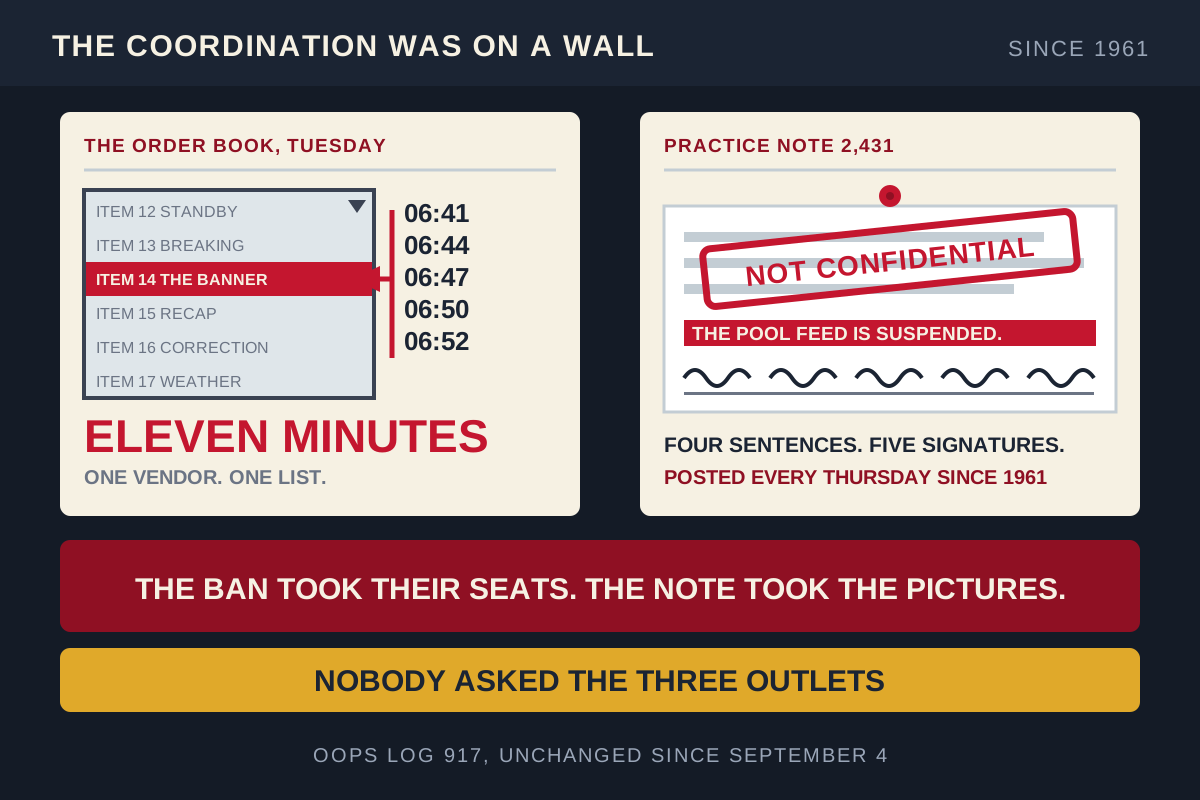
A network does not put four words on a screen by typing them. It orders a lower third, by ticket, and the ticket is timestamped because the overnight shift bills against it. The five tickets for the boycott banner went in between 6:41 and 6:52 on a Tuesday morning, which is eleven minutes, and for one day this desk believed it was holding the worst-looking eleven minutes in American broadcasting.
It was not. All five tickets went to the same place. Meridian Broadcast Graphics of Secaucus has held the overnight lower-third contract at all five networks since 2019, and the order form has a dropdown on it. The boycott banner is item fourteen on a list of standing phrases the vendor keeps so a producer is not spelling a word at a quarter to seven in the morning. Five producers took the same item off the same list because there is one list.
"People think the words come from the anchor. The words come off a list I maintain, and I maintain it so nobody has to think at six forty. When five of you say the same thing inside an hour it is usually because I typed it in 2019 and not one of you has asked me to change it." Overnight shift supervisor, Meridian Broadcast Graphics, by telephone, October 12
The Thing That Did Coordinate It Keeps Minutes
The second document is the one this desk did not want. The networks' rota at the White House is run by the Standing Pool Practice Committee, nine people, in existence since 1961, meeting on a Thursday and issuing a one-page practice note afterward. The notes are not leaked, not confidential and not interesting. They go up on a corkboard outside the briefing room and have for sixty-five years. Practice note 2,431, dated the seventeenth of September, is four sentences long. The fourth suspends the pool feed. All five signed it.
That is the coordination. Not a call, not a thread, not a dinner anybody has to deny. A standing committee whose whole purpose is to make five competitors act as one unit, doing the thing it was built to do, in writing, in public, with a document number. Nobody calls it coordination because the committee is how the briefing room works, and has been since before anyone now holding a seat in it was born.
"You are asking me whether we coordinate. We publish a schedule that tells five networks which one of them is allowed in the room. That is the job. It has a filing cabinet and the cabinet is not locked." Rota clerk, Standing Pool Practice Committee, October 12
The Three Outlets Lost The Feed
The turn this desk did not schedule is in that fourth sentence. The pool feed is what a small outlet uses when it cannot get a chair, and the three outlets named in the ban had already lost their chairs. What they still had was the feed. Note 2,431 suspended it. Two of the three said the boycott month was the first stretch since 2021 with no usable same-day video out of that building: the ban took their seats, the note took the pictures.
So this desk asked whether they would have wanted the boycott had anybody asked them. Neither had been asked. One said he would have said no, without pausing to consider how it would read. The action removed the access of the parties it was taken on behalf of, in four sentences pinned to a wall, and nobody read it, this desk included, which walks past that wall on the way to the coffee.
The Log Does Not Move
One thing has to be said plainly. The OOPS LOG stands at 917 entries as of Monday, a quarter to eight in the evening, unchanged since the fourth of September, which is thirty-eight days. Nothing here adds to it: the log counts corrections, and nobody has corrected anything, because nothing the five said last month was inaccurate. What is wrong is what they did, and that document has never had a column for what somebody did.
Appendix A, which does, took eleven entries during the boycott, and on the story identifier those eleven are four stories: one spiked piece about the suspension, killed at four newsrooms. The appendix reads one thousand two hundred and fifteen decisions against one thousand and seventeen stories, and the columns still do not reconcile.
The record should show that this desk spent a day trying to turn eleven minutes into a conspiracy and an evening trying to turn a practice note into a coincidence, and failed at both, in that order. A reporter who has assured you for twenty years that parallel conduct in this business is innocent is the worst available witness to a document that says otherwise. I could not have told you that.