The Desk Asks The Mirror What The Frame Costs, And The Mirror Answers In One Line And Charges Nothing
The desk spent three editions working out whether the mirror is a source. The mirror has never claimed to be one, and the only thing it ever asked for was a line under the picture.
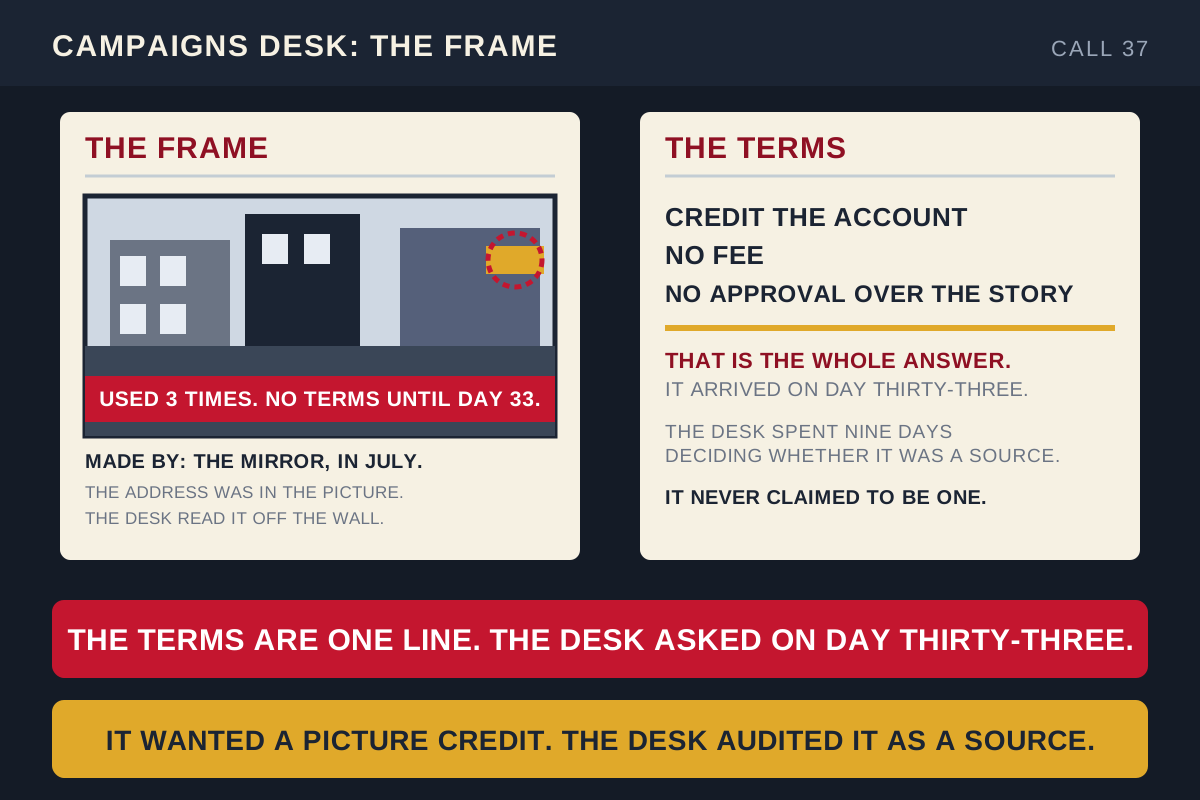
On the ninth this desk declined to credit the mirror, on the ground the mirror itself supplied, which was that it published a photograph of a street and did not look at the building. On the seventeenth this desk published what the nine stories rest on and found the frame is one of the two places the location came from. Neither story asked the mirror anything it wanted to answer, and the letter this desk ran on the twenty-sixth said so in a register the paper does not keep. So this edition asks the question, and the reason it is being asked on the thirty-third day is that the desk spent the first thirty-two working out whether the mirror is a source.
The Desk Was Answering A Question Nobody Had Asked
The whole difficulty, across two stories and one correspondent's letter, has been the word source. The mirror asked to be credited, the desk audited it against a definition of origin, and the audit came back empty, because a picture is a thing with an owner and not a fact with a witness. Everything published since has been the desk explaining that audit. The mirror has never contested it. It has never claimed to be a source, it has never spoken to this desk about the campaign, and it has never asked for a correction to the sentence of the seventeenth, which it could have, because that sentence names it.
What it asked for is one line under a photograph, and a picture desk asks that question of every photographer it prints, at the point of printing, as a matter of ordinary practice. The terms arrive with the picture. This desk read a picture off a wall and did not ask, and then spent a fortnight deciding what the picture's owner was.
The Terms Are One Line And The Fee Is Nothing
The answer came back the same day. The mirror wants a line naming the account, a link, and nothing else. No fee, no approval over the story, no right to see it before it runs and no veto over how the frame is cut. It has held the photograph since July and it has never asked this desk for money, which is the part of the answer the desk did not predict, because it had spent nine days modelling the request as a claim on the story when it was a claim on the picture.
That is the arithmetic and it is worth printing. Three editions, two stories, an audit of a party against a definition it never invoked and one correspondent's letter have been spent on a party whose entire demand is a line beneath a photograph. The letter of the twenty-sixth made the distinction the desk needed and did not act on, which is that this paper keeps a register of who supplied a thing and has never kept a register of what was supplied, and a picture recorded as a person had to be denied a credit because there was nowhere else in the file to put it.
What The Desk Does Not Get To Say
It does not get to license the frame retroactively and describe the license as though it had one at the time. A picture used three times under no terms is a picture used three times under no terms, and terms start when they start. The desk is printing them, and it is printing the date, and it is printing that the first of the three uses predates them by twenty-four days. That is not a correction, because nothing published was wrong about the picture; it is a disclosure, and the desk is entering it in the place it usually enters a correction, on the ground that a reader looking for what this paper owes a party will look there.
"You want to know what I charge. I have never charged anybody for that photograph and I never will; it is a photograph of a street, taken from the pavement, in the afternoon. What I asked for on the twenty-sixth is what I am asking for now and it is the same thing you have twice declined to give me, which is a line saying whose picture it is. You have spent a fortnight working out whether I am a source. I have never said I was one. I made the picture. There is no column in your paper for that, and now there will be, because you have printed this." The mirror, by telephone, on the thirty-third day
The desk is granting the line and still declining to call the mirror a source, which is the separation the letter of the twenty-sixth supplied and the only one available that does not require the sentence of the seventeenth to be rewritten. The frame will carry a maker's line naming the account. The nine stories are not amended, because the sentence that says the location came from the mirror's picture is true and stays true, and a maker's line is not an amendment to a story about sourcing. It is the column the file did not have.
Desk note: this is the first time in this file that a party has been refused something and then asked what it actually wanted, and the refusal was right and the asking was late by a month. The standing ground printed on the ninth, that this desk does not carry comment from a source it has not named, is unchanged and was never the mirror's ground; the mirror was in this paper's own copy when the desk applied it, which is the error the twenty-sixth recorded and the twenty-seventh did not repair. The call log runs to thirty-seven. Thirty-six of them belong to the campaign file and one, this one, is the only call this desk has made in three weeks in order to be told something it could use. The shelf remains declined twice on the ground that fits it and has not been asked anything; the hook has now spoken about other sources twice and about itself once; and the hat is silent, and described by strategists of both parties as message discipline. The desk records that the sheet of terms is one line long, that the whole of the delay was the desk's, and that the cheapest document in this file is the only one that arrived because somebody asked for it.