Greenland Exploration Begins After The Security Desk Finds The Map Has A Door On It
The file contains oil, gas and minerals. The first item to move through the arrangement is a permit, and this correspondent has covered less secure corridors.
The president said exploration for oil, gas and minerals would begin in Greenland and praised the security advantages of last month's deal with Denmark and Greenland. This correspondent has covered international arrangements for thirty years and has learned that a security advantage is generally announced before anyone can identify the door through which it entered. The desk therefore went to the map.
The First Advantage Was A Route
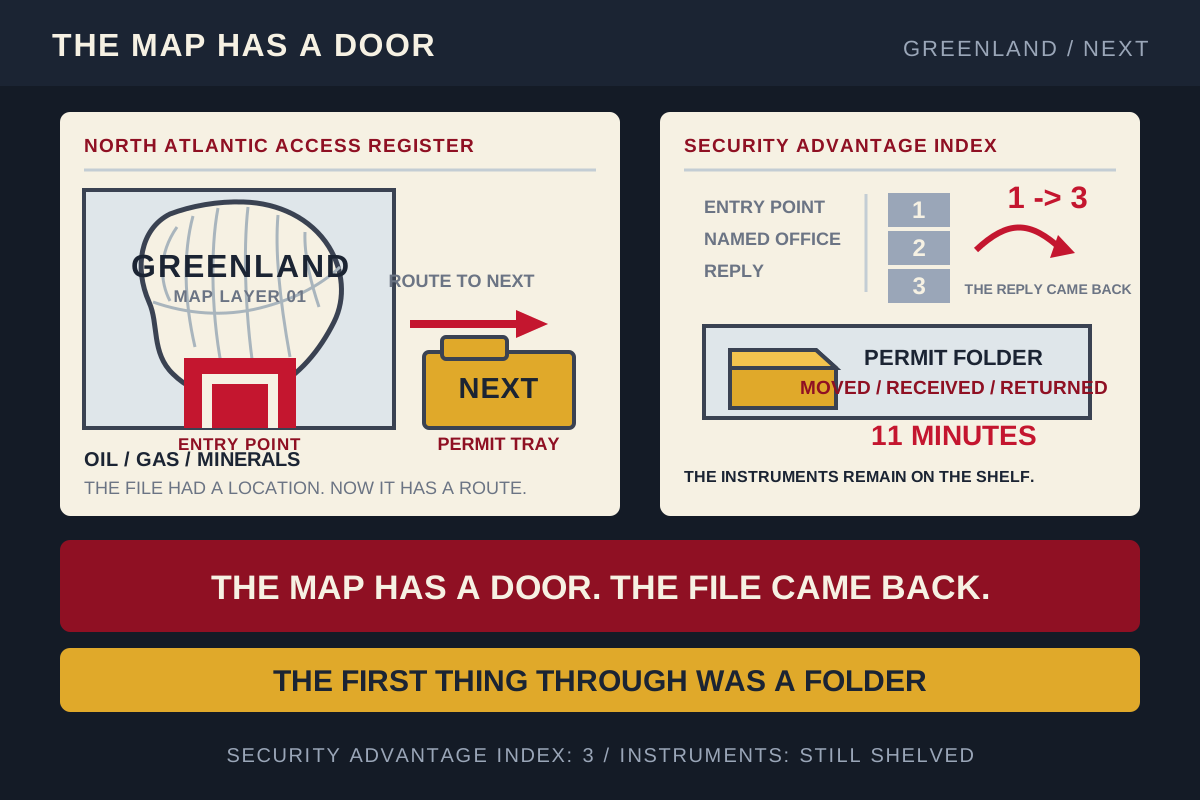
The North Atlantic Access Register occupies a room with three maps and one radiator that has been described by three successive administrations as temporary. The first map marks oil, the second gas and the third mineral deposits. Until last month, the exploration file could be placed on any of them, but it could not be moved between the map and the desk where somebody signs for it. There was no arrow. The file had a location and no route.
The register now carries a red gate symbol between Greenland and a tray marked NEXT. The symbol is not a port, a base or a claim on the territory. It is a way of showing that a document may pass from the map room to the office that is meant to answer it. The security desk has counted this as an advantage because it is the first thing in the file that can be secured without being guarded.
"We have always had the map. What we did not have was a place on the map to put the permit after somebody said yes. A route is not glamorous, but it is how a folder gets back to you." A registrar in the North Atlantic Access Office, by telephone, Wednesday
The Index Rewards The Boring Door
The desk's Security Advantage Index has three columns: an entry point, a responsible office and a reply. It was designed in 1998 by a committee that believed a fourth column would encourage optimism. A file scores one when it has somewhere to go, two when somebody is named to receive it and three when the receiving office sends the file back with a noun still attached. The Greenland page had scored one for eleven years.
The new page scores three. The map room sent the exploration folder to the office listed beside the gate, that office answered the email, and the reply used the same word for the document the map room had sent. This is not a dramatic improvement. It is the administrative equivalent of discovering that two people have been discussing the same door, rather than two different doors on opposite sides of a building.
This correspondent covered a 1990s corridor in which three governments had placed their flags on a table and none could identify the key. The arrangement was described at the time as stable. It was stable in the sense that the table did not move, which is a category of stability the current map room has declined to use.
The Permit Arrived Before The Instruments
The first test was not whether an instrument could reach Greenland. The instruments are still in the storage ledger, where they have been since the storage clerk's predecessor gave them a shelf number and no date. The test was whether the first question sent through the new gate would come back with an answer, and whether the answer would still concern exploration rather than the location of the form.
It did. The register marked the permit folder moved, received and returned in eleven minutes. The map room then moved it again because the first answer had been filed under security, which is how the desk learned that a route can be open and still lead to the wrong cabinet. The second reply used the correct noun. The gate remains open. The instruments remain on the shelf.
"The security benefit is that we can now tell the difference between a question that has crossed the border and a question that has merely been admired from this side of it. We have been admiring a lot of questions." A map-room clerk, in a written response, Wednesday
A Door Is Not A Doctrine
The desk set out to measure whether the language of security had outrun the usefulness of the arrangement. It has not, although the useful part is smaller than the language. The advantage is not a new doctrine, and it is not a force that can be placed on a map. It is a route that allows an exploration file to be answered by the office it reached, which is modest and, in international affairs, not nothing.
Whether this represents a turning point or merely an anomaly in a longer pattern of adequate-to-middling corridors is a question this correspondent declines to answer prematurely. The door is open. The map is still the map. The file has, for the first time, come back through it with a noun attached.
This correspondent has covered seventeen NATO summits. This one was the first security review to produce a door that opened in the direction marked exploration.