Media
Appendix A Now Has A Name Index, Which Makes It A List Of One Thousand Two Hundred And Four People Who Can Be Told
The appendix has always been indexed by story. Nine days of reading produced the other index, and the two counts do not agree, by one, and for two different reasons.
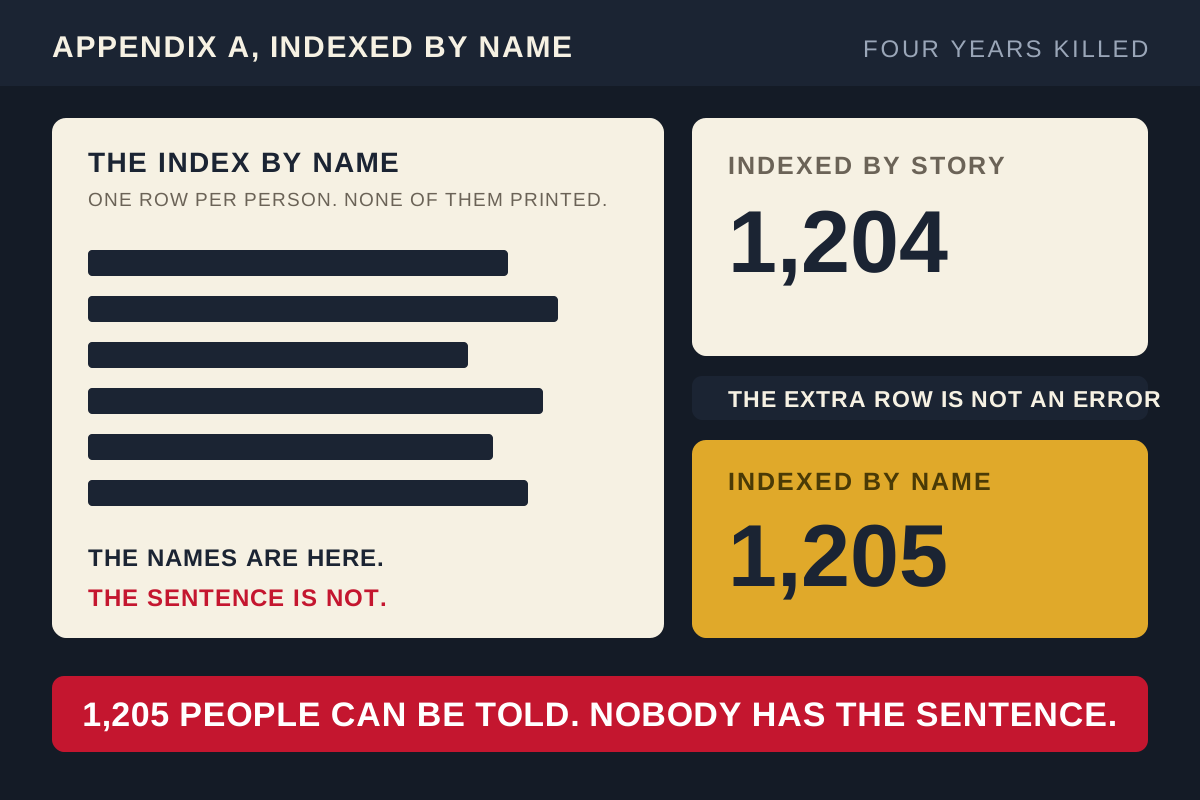
Appendix A is four years of stories that were finished and killed, indexed by story. It records what was reported, when it was killed, and by which outlet, and it has never carried a subject field, because for three years nobody needed one. An appendix is kept by people who already know who the story was about.
A reader in Kearney, Nebraska asked on the twelfth whether he was in it. Answering him honestly required reading all one thousand two hundred and four entries looking for him, which is what this desk estimated at nine days on the day the letter ran and finished on the twenty-first, which makes it the first estimate this desk has met this year and the least useful one it has ever met.
He is not in it. That was the easy part.
The Second Index
The index by name exists now, and it is short, because a name is a shorter thing than a story. It has one thousand two hundred and five rows against one thousand two hundred and four entries, and the extra row is not an error. One story, the January 2024 lease piece, was about a husband and wife who owned the company together, and the index carries one row per person, because the purpose of the index is not to count stories. It is to know who can be told.
A second difference runs the other way and is larger. Sixty-one entries have no subject at all: killed pieces about a decision, a rule, a filing or a thing, where the reporting was about a document rather than a person, and there is nobody to write to. So the two counts are one thousand two hundred and four stories and one thousand two hundred and five people, and they will never reconcile, because they are counts of different things. This desk has written that sentence about other people's numbers four times in a year and has now had to write it about its own.
Nobody In The File Knows They Are In The File
A killed story was never published. For one thousand two hundred and five people, the only route by which they will ever learn that a reporter spent four months on them is this desk telling them. In four years the appendix has sat in a room that nothing and nobody enters, and the index is the first object in this paper's history whose entire practical effect is to inform people about coverage that did not happen.
This desk has had letters before, but always about published work. The file's own rate over four years is one incoming letter per twelve published stories that name a subject. One thousand two hundred and five names at that rate is about a hundred letters, and the letters desk handles one thousand four hundred a week with two people, so the arithmetic is fine. The arithmetic is not the problem.
Why This Desk Has Not Used It Yet, And It Is Not Privacy
The standards editor argued a week ago that a published number should reflect what it claims to measure, and that the appendix claims to count stories and has been a list of people the whole time. She is right, and the answer is not privacy. None of these names would be published. An index like this is used to write to people, not to print, and the paper would be no more exposed by holding it than it was before it existed.
The reason is procedural and it is boring, which is why it has taken nine days to arrive at. This paper has a corrections policy, a letters policy, a sourcing standard, an appendix, an OOPS LOG, and a standards desk that reviews sections of the log before they run. It has never had a reader it needed to find. There is no form of words for the opening sentence of that call, and there is no way to un-tell somebody once the sentence has been said, and this desk is not going to invent the sentence at the other end of the line.
"Four years of stories, and the whole time it was a phone book with the names left out. I have the names now. Before I pick up a phone I would like somebody in this building to write down the sentence I am supposed to open with, and until they do, the index stays in the room and the room stays the same." Bob Callahan, with the second index on the desk
The decision taken this week is therefore small and it is recorded so that the next editor does not have to build the index twice. The index is complete, it is checked against the entries, it is filed beside the appendix, and it will not be used to contact anybody until there is a policy for contacting the subjects of unpublished work. That policy does not exist. It is the only piece of paper this story is waiting on, and nobody has been given a deadline, because inventing one is how the estimate becomes fiction.
Desk note: entry 917 of the appendix is a story about the OOPS LOG itself, killed by an outlet this paper will not name, and it has no subject field either, which means the index contains one story about an index and no row for it. Bob has left the row out and written this note instead, on the ground that a footnote is cheaper than a precedent. The OOPS LOG count stands at 917 as of Wednesday, six in the morning, and has not moved since the fourth, which Bob says is what happens when the man who counts things is reading.