Polling
The Nineteen-Question Instrument Is Retired, And Four Years Of This Desk's Economic Trend Cannot Be Moved To The Short One
The short instrument makes no fatigue bloc to weight against, because fatigue needs length to accumulate. There is no conversion. This desk has spent a week looking for one.
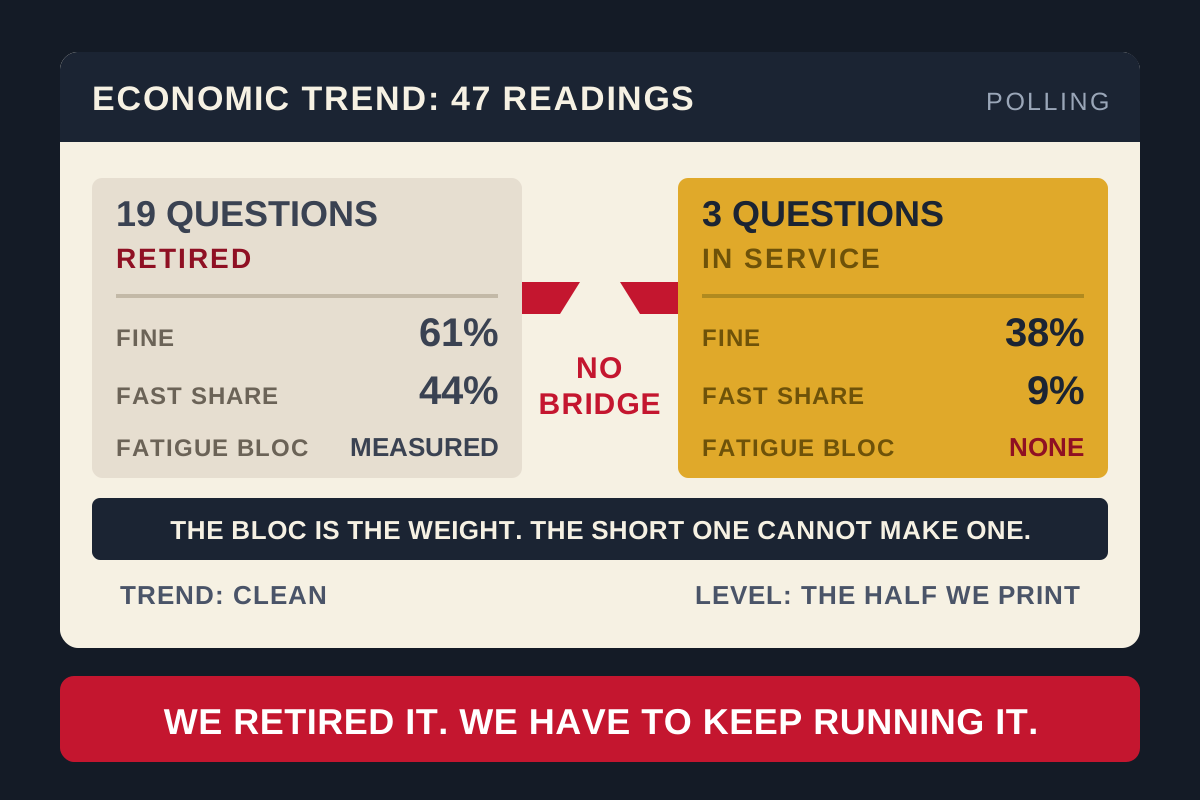
This desk is retiring its nineteen-question economic instrument. It was written in 2022, it has been in the field every month since, and on the eighth of this month it produced the finding that ends it: 61 percent said the economy was fine, 29 of them meant good, 31 meant that the conversation should end, and the bloc that meant stop asking was assembled by the instrument itself, question by question, across eleven minutes. A desk that has printed that cannot keep the instrument. The retirement notice took an afternoon to write.
The four years behind it have taken a week, and they are not resolved.
This desk's economic trend runs monthly from October 2022. Forty-seven readings. It is the most cited thing this desk produces and the only series it has ever kept unbroken. Every one of the forty-seven was taken on the instrument being retired.
There Is No Conversion
The obvious move is to restate the series on the three-question instrument and carry on. It cannot be done, and the reason is not arithmetic. A weight corrects a sample for a property the sample has: age, region, education, turnout history, and since 2023 the fatigue bloc, which this desk weights against because it knows the size of it. The three-question instrument does not make a fatigue bloc of measurable size. Nine percent answering fast at three questions is not a small version of forty-four percent at nineteen. It is the floor, the share that answers everything quickly, and it is present in every instrument this desk has ever fielded.
There is nothing on the short instrument to weight against, because the property the weight corrects for is not there. So the 38 and the 61 are not two readings of one quantity taken with different tools. They are two quantities.
The 214 respondents who took both in the same September week were meant to be the bridge. They returned 62 percent long against 37 short, and that ratio is a conversion for 214 people, in one week, on one economy, with one set of headlines behind them. Carrying it back to October 2022 assumes the fatigue bloc has been the same size for four years, which is the one thing this desk cannot check, because it did not start measuring the bloc until it found it.
"You are asking me to restate four years on an instrument that cannot produce the thing the four years were corrected for. I can give you a number. I cannot tell you what it is a number of." The desk's weighting statistician, asked a fourth time
What Keeping It Costs
There is exactly one way to keep the series, and the field house proposed it inside a minute. Run the nineteen-question instrument alongside the short one, every month, indefinitely, unpublished, as a calibration standard. It works. It is also this: in order to go on reporting a trend whose central finding is that a long survey manufactures a bloc of people who want the survey to stop, this desk must field a long survey every month, to respondents it now knows will be worn down by question fifteen, for the express purpose of producing the bloc it needs in order to measure the bloc.
The instrument would be retired from publication and kept in service to keep doing the thing it is being retired for.
The field house does not see the difficulty and never has. An instrument that is not published is not a poll, it is an instrument, and calibration standards exist to be run rather than reported. On its own terms that is correct. This desk asked what it comes to in people. It is about 1,100 a month, asked nineteen questions so that one number can stay comparable to itself.
Which Half Was Ever Clean
Underneath all of that is the finding it took the week to see, and it is the reason the file is still open. The fast share runs 11 percent at question three and 44 percent at question nineteen, and the instrument's length never moved: nineteen questions in October 2022, nineteen in September 2026, same wording, same order, same card. The contamination is therefore constant, and a constant cancels out of a difference and does not cancel out of a level.
So the movement in this desk's economic trend is clean. Every rise, every fall, every month-on-month figure it has published since 2022 is measuring what it says it measures, and was doing so on the days this desk had no idea the bloc existed. The level is the compromised half.
The level is the half this desk leads with. Sixty-one percent say the economy is fine, printed as a number, at the top of every summary, for four years. The correction this desk ran on the eighth conceded that twenty-six prior economic summaries printed fine as one number while the desk held the split. The larger concession is the one that correction did not reach: the number in the headline was the wrong half of the instrument to put there, and the half that was sound the entire time is the one this desk has been burying in paragraph six.
The Institute of Applied Sentiment has ruled that the long instrument is the valid one, on the ground that it collects more data, which is true and is also the ground on which it collects the bloc. This desk records the ruling and does not endorse it, which is now the third consecutive time, and notes that the Institute has begun citing that coverage as recognition. What this desk will publish going forward has not been decided. It is publishing the fact that it has not been decided, because the alternative is to decide it quietly and print the result as a trend.
Desk note: The margin of error has filed its seventh request this year to be left out of it. The desk has honored it, as it has honored the previous six, and records that on this occasion the request was unnecessary. A figure that cannot be restated on the surviving instrument does not have a margin of error. It has two instruments and no bridge between them, which is a different kind of uncertainty and not one the margin is answerable for. The margin was informed of this. It did not reply, which is the first time.