World
A Second Defense Ministry Justified Its Budget By Citing The First One's Budget Annex, And The Ministry Cannot Work Out What The Objection Is
The second ministry did not cite the transcript. It cited the neighbour who cited the transcript, and it has an auditor who will explain at length why that is the better source.
This correspondent has covered international affairs for thirty years and spent twenty-nine of them not reading budget annexes. That ended on the thirty-first of August, when this desk printed a correction conceding that a document it had needed for eleven months had been published, in full, for eleven months. The remedy adopted was not sophisticated. This desk began reading the annexes.
Eleven member states publish their line-item justification registers without redaction, on the sound theory that nobody opens them. The second one this desk opened was a schedule of the same kind under a different name, and the entry for last year's increase cites, as its justification, Annex C of the ministry reported here on the thirty-first of August. It cites it properly: ministry, document, year, page, entry number. A reader could find it in under a minute, and this reader did.
The second ministry did not cite the transcript. It cited the country that cited the transcript. Its stated reason for spending more is that its neighbour began spending more, and its evidence for the neighbour's spending is the neighbour's own audit register, which is a better source for that fact than anything the neighbour has said out loud since.
The Objection, Put Twice
This desk telephoned expecting a press officer and a fortnight. It was given an auditor the same afternoon, who answered every question directly and was audibly puzzled by all of them.
"A justification register records the reason and the best available evidence for it. Their register is better evidence of their spending than their podium is. If a superior source exists you cite the superior source. I am not sure what you are asking me." A budget auditor who volunteered her name and was persuaded with difficulty to withhold it
Asked whether it gave her pause that the chain behind her entry terminates in a transcript of an American president telling this alliance in public that its members were not paying, she asked whether the transcript was in dispute. It is not. She said that settled it, and returned to the question she thought had been asked, which was about page numbering.
This desk put the objection a second way, which is the courtesy owed to anyone who might simply have misheard it the first time. The answer came back at greater length and with a worked example. There is no evasion in this story. There is a profession that has been doing an ordinary thing for decades and a press corps that has never once asked it about the thing.
How Far It Goes
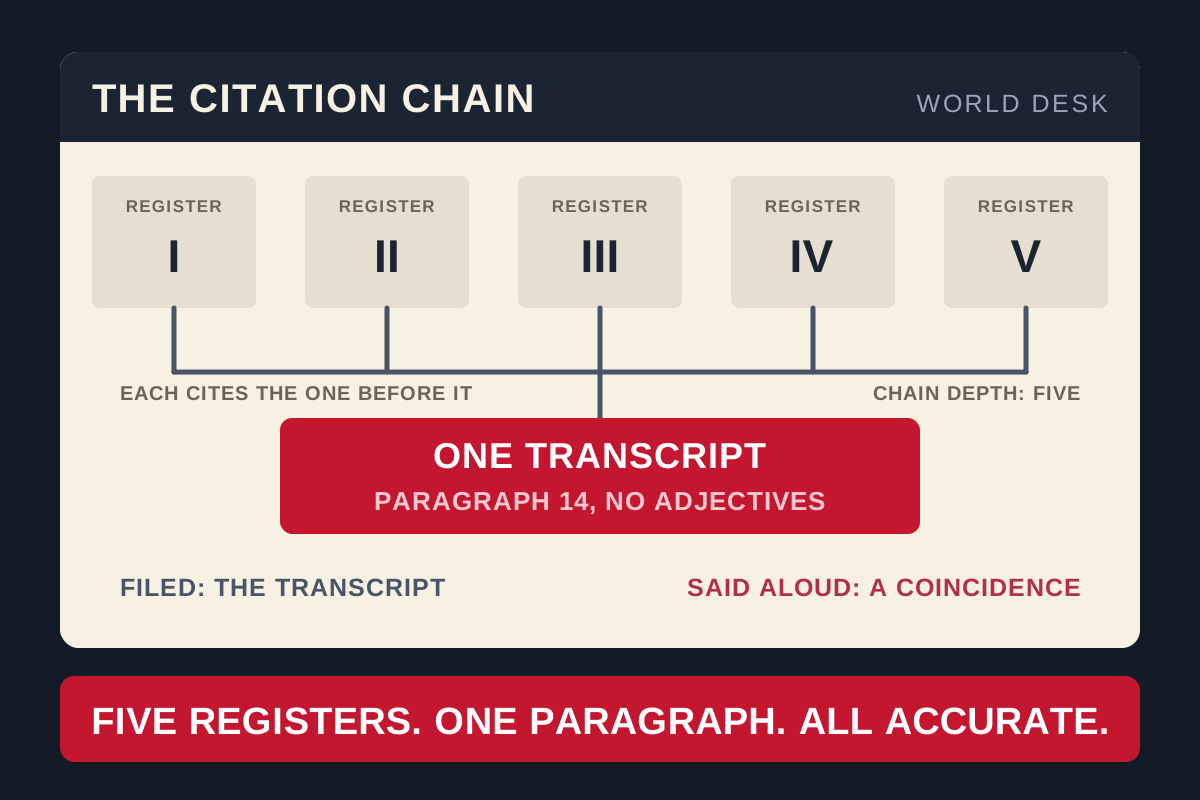
Four days with six registers produced a chain five ministries long. The third cites the second. The fourth cites the third. The fifth cites the first and the third together, which makes it the only entry in the sequence that names two sources and therefore the only one that reads like an argument rather than a filing.
Every branch terminates at the same node. Annex C, the September entry, the transcript, the date, the paragraph number, no adjectives. Five governments, five currencies, five defense ministries that do not agree about procurement, ammunition standards or the word deterrence, and one citation at the bottom of all of it, recorded in five languages by people who were not coordinating and had no reason to.
In public, over the same period, the same five governments have attributed the same increases to an industrial strategy, a generational renewal of the armed forces, a deteriorating security environment, an alignment with European partners, and, in the case already reported here, a coincidence. Each of those statements is true in the way that press statements are true. Not one of them cites anything.
The Concordance
This desk asked all five who reconciles the public reason with the filed reason. Four answered, in substance, that nobody does, because the documents are written for different readers and neither reader opens the other's. The registers are not revised for presentation. The speeches are not footnoted. The two accounts run in parallel and are never brought into the same room.
The fifth brings them into the same room every March. A finance ministry there publishes an annual concordance of public rationale: a nine-page table mapping each public statement about the defense budget to the register entry it corresponds to. Column one is the statement. Column two is the entry. Column three is for register entries with no matching public statement, and column three is the longest column in the document and has been since the table was introduced in 2011.
It was not built to disclose anything. It was built because the same auditors kept being asked to reconcile two numbers by hand and grew tired of it. It has never been the subject of a press release. It is filed as an appendix to an appendix, and the officer responsible would prefer the coverage stopped.
"It is not a disclosure document, it is a filing aid. I am told it has been called courageous. I would be grateful if that were not repeated." A concordance officer, by telephone, twice
What The Record Will Say
The public history of this period will be assembled from the speeches, because the speeches are what was said to the public and there is a great deal of them. The documentary record will be the registers. They are complete, dated, cross-referenced, accurate on every point this desk has been able to check, and they converge on a single paragraph. They were compiled by accountants with no interest in how any of it reads and no instruction to make it read any way at all.
This correspondent covered the enlargement debates of the 1990s, in which this alliance argued for four years about its own motives and produced, on request, no document in which anybody had written one down. Measured against that, five ministries that file their actual reason, cite each other's filings correctly, and maintain an index of who cited what represent an improvement the 1990s could not have produced if asked, and were asked. That the improvement is the work of auditors rather than of anyone elected to it is the only remarkable thing in this story.
Whether a record that is complete, accurate, public, and read exclusively by accountants amounts to transparency or merely to bookkeeping is a question this correspondent declines to answer prematurely.
Reporter's note: The map has a second colour now. It marks the countries whose registers cite one another, it currently covers five of them, and it is the first thing in twenty-two years the red ink has had to share a page with. The red figure has not moved.