The Institute Of Applied Sentiment Has Ruled On A Measurement Nobody Submitted To It, And The Ruling Stands Because Appealing It Would Concede It Has Jurisdiction
The Institute's charter says it acquires jurisdiction when a party responds to a ruling. Nobody has responded. Fourteen summaries now cite the ruling rather than the instrument.
This desk put three questions in the field without a name on them, on purpose, because the retired nineteen-question instrument had a name and the name was doing work the three questions cannot do. Twelve days later fourteen summaries had given it four names. On the twenty-fourth this desk reported that and reported that the Institute of Applied Sentiment had issued a ruling on which of the four is correct. The ruling arrived by courier. This desk did not submit anything to the Institute. This desk has never submitted anything to the Institute.
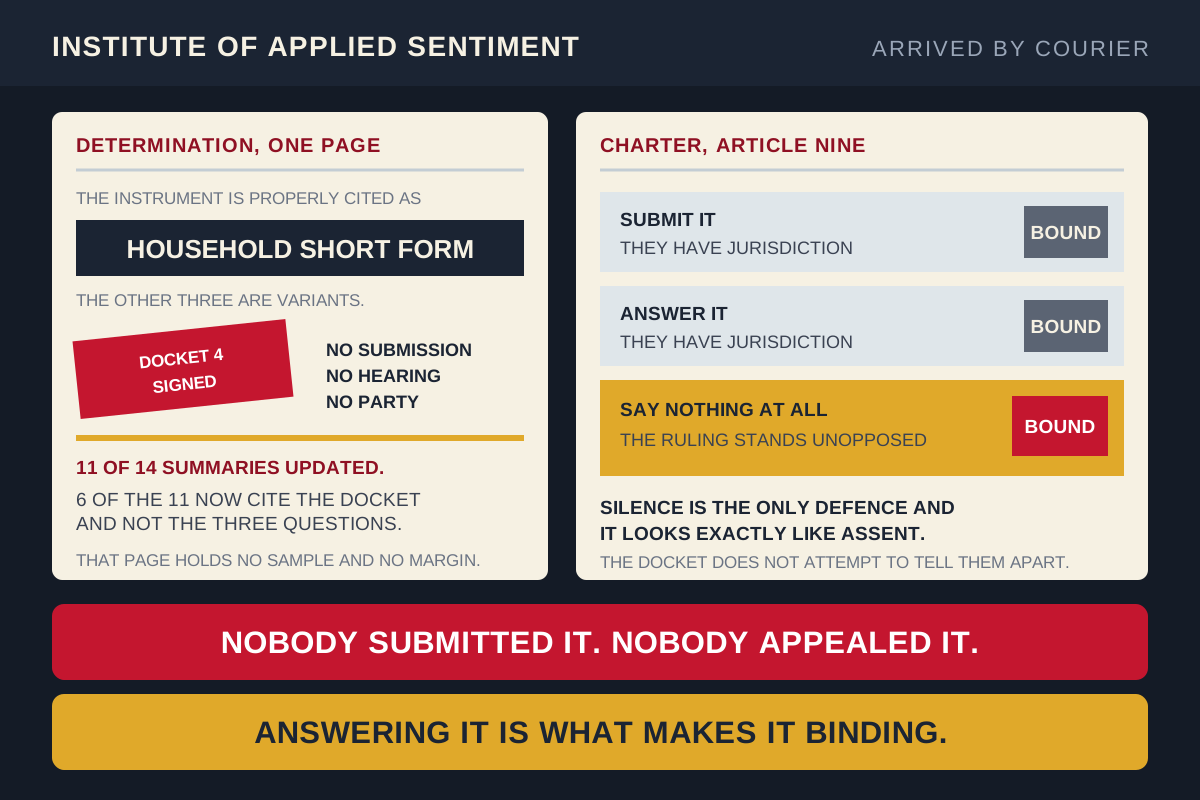
The ruling is one page. It holds that the instrument is properly cited as the Household Short Form, which is the third of the four names and the one this desk likes least, on the ground that it is the name used by the largest number of citing outlets, and it directs that the other three be treated as variants. It is signed. It has a docket number. The docket number is the fourth this desk has seen from the Institute and the first in a matter this desk is a party to.
Article Nine
This desk has now read the Institute's charter, which is public, is eleven pages, and has been in force since 2011. Article nine is the operative provision and it reads, in full, that the Institute's jurisdiction over a measurement is established by the submission of that measurement or by the response of any party to a determination concerning it.
Read that twice, because this desk read it four times before it did what it does. The Institute may rule on anything. The ruling is of no effect until somebody answers it. Answering it is what makes it effective. So a party who believes the Institute has no business ruling on her questionnaire has exactly one instrument available, which is silence, and silence is also what a party does who agrees with the ruling, and the Institute's docket cannot distinguish the two and does not attempt to.
"You are welcome to appeal. The appeal form is on the website. I would not characterize filing one as an admission of anything, and I would not characterize it as not one either, and that is the honest answer to the question you asked." The Institute's secretary, by telephone, October 7
What The Fourteen Summaries Did
Here is the part that settles it, and it took nine days and is the only new number in this piece. Of the fourteen summaries that cited the three questions under four names, eleven have now been updated, and all eleven now cite the Household Short Form, and six of the eleven cite the ruling rather than the instrument. That is to say the footnote in six published summaries points at a one-page determination by a body with no relationship to this desk, and not at the three questions, the field dates, the sample or this desk.
The three questions are now, in six places in the literature, a thing the Institute has defined. This desk wrote them, fielded them, paid for them and published them, and the citation of record is a docket number. That is not a complaint about credit. It is a methodological statement: a reader following those six footnotes arrives at a page that contains no questions, no sample size and no margin, and the thing the footnote was for cannot be checked from where it lands.
This Desk Is Not Appealing
So the ruling stands and it stands for the single reason that it has not been answered, and this desk is choosing not to answer it in the one register the Institute recognizes, which is its appeal form. This column is not that register and the secretary confirmed as much without being asked, which this desk has decided to take as courtesy rather than as a trap.
What this desk is doing instead is the only thing available, which is to keep publishing the three questions in full, with their field dates, their sample and their margin, at the top of every reading, so that a citation to the questions is always cheaper to make than a citation to a docket. That is not a remedy. It is a price adjustment, and this desk expects it to work on about half of the eleven.
Wire note: the three questions have had no name for thirty-four days and have been cited under five, four from outlets and the fifth from the Institute, and the Institute's is now ahead. The margin of error's standing request to be left out of it is noted and in this case honoured, since the ruling does not mention a margin, which is this desk's chief objection to it. This desk records that it set out in September to avoid making one precise claim by refusing to name an instrument, and has now had the instrument named by a body that acquires authority from being argued with, which is a cleaner trap than anything this desk has built on purpose.