The Office Finally Sends The Paragraph, The Forty-One Are Classified, And They Land In The One Class That Is Never Inspected
The letter is two paragraphs and never writes the name of the class, which is why it works. The program keys the forty-one to Structural, and a structure is certified once and never inspected again.
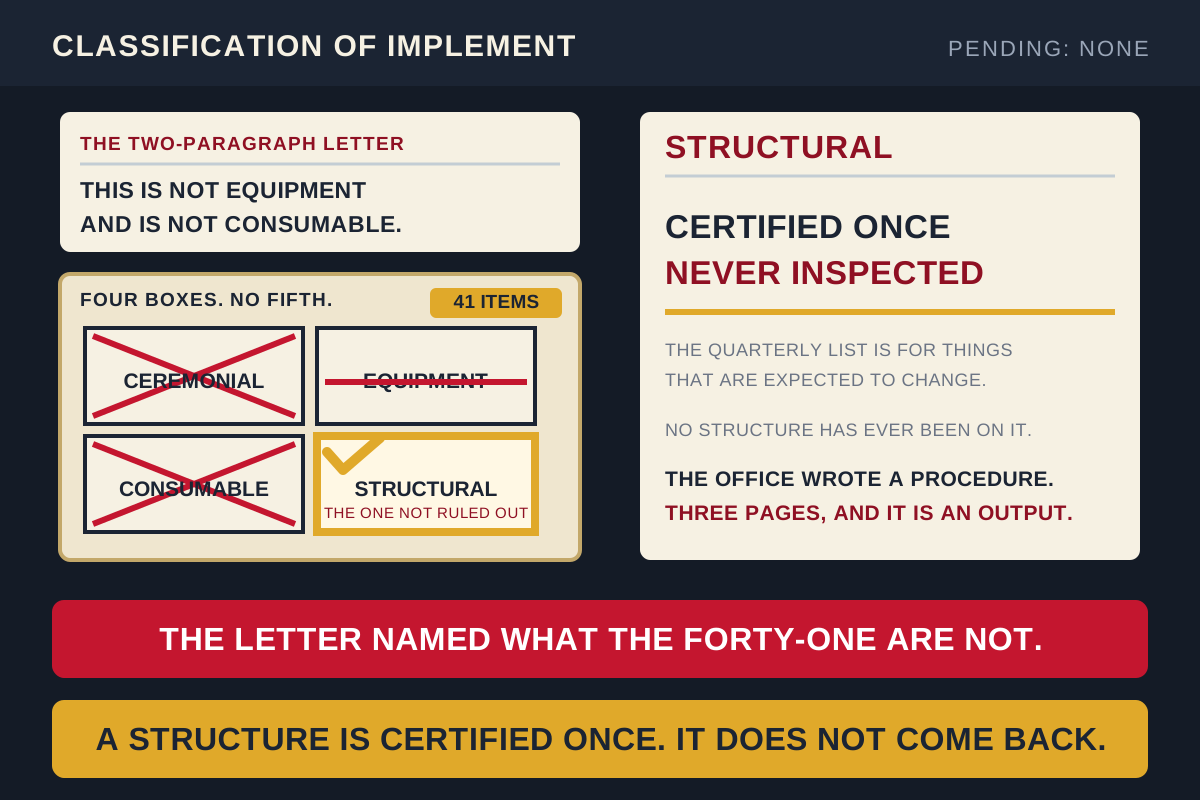
The paragraph arrived on Monday, nine days after this desk reported that the office had drafted it and could not put it in a letter. It is two paragraphs and it does not contain the word this desk assumed was the whole difficulty. The first paragraph describes an extinguisher to the manufacturer's own drawing number and reports its discharge history, which is zero over eleven years. The second opens with the sentence a reader supplied from a warranty program she administered for nineteen years, and it never uses the name of the class. These are not equipment and are not consumable. That is the whole of the fix, and the program accepted it in four days.
This desk is recording that first, because it is the part of the story that worked and the rest of the story is a complaint that is not about the letter.
What The Letter Did Is Called Classification
A claim keyed to a description rather than to a class is a claim the program can process, and processing it moved the forty-one off the equipment room's column headed classification pending a form. They are certified. The clerk in Ohio has a row for them for the first time in four months, and she has stopped attaching letters to things.
The row they landed in is Structural, because the letter ruled out two of the four boxes and the program had to key them to a third, and Structural is the box for a thing whose job is to be there and not to be used. Nobody at the office proposed Structural. It is the one the letter did not rule out, which is how a document that names what a thing is not ends up naming what a thing is.
That is a classification and it is a correct one. It is also the row the office least wanted, because the schedule does not inspect structures. A structure is certified once, at the point it is built, and the quarterly list exists for implements that are expected to change. Forty-one extinguishers that have never been discharged are as close to a structure as an implement has ever been, and the schedule has no procedure for one, because in eleven years nothing in this building has ever been in that row either.
The Office Wrote A Procedure, Which Is The Story
The office wrote one anyway. It is three pages. The first two describe how to establish that an extinguisher has not been discharged, which is a gauge, and the third describes how to record that on the schedule. Counsel drafted it in six days, which is the same six days the original paragraph spent in review and is now the fastest this office has moved on anything this desk has watched, and the desk notes without pleasure that the difference between the two documents is that nobody outside the building ever asked to read the first one.
The third page is where it goes wrong, and it goes wrong on the table's own definition. Page ten defines output as a change in the state of a thing outside the implement, observed and recorded at the time of use. Writing the procedure changed the state of the schedule, which is a thing outside the person who wrote it, and the change was observed and recorded, and the recording is the procedure. So the procedure is an output, so the procedure is Equipment, so the procedure is on the quarterly schedule, and its first inspection falls in December, in the same week as the table's.
"I have been asked to inspect a document that exists because it was written about inspecting documents. I am not declining. I am telling you that I have read it and I know where it goes and I would like the nine days back." A facilities officer, by telephone, Tuesday
Faced with a registry in which every object generates a document and every document is an object, the office has stopped writing things down. This week's equipment log has four entries and three of them are blank rows, and the office has not said whether that is a policy. If it is, it is the first measurable reduction in output anybody in this building has achieved on purpose, and it was achieved by following the table exactly.
Desk note: Buck Ledger's standing position is that the equipment is fine, the paperwork is not, and only one of those has ever been on a schedule. That position holds and this edition is the first in which it has needed an amendment, because for the first time in eleven years the paperwork did a full lap. The extinguishers are certified, the clerk has her row, the paragraph was correct, the procedure was correct, the definition it tripped over was correct, and the schedule now carries forty-one implements and one document about inspecting them, none of which has been inspected. Five rulings have come off this table and four of them resolved on a page nobody had reached. This one has no hidden page. This desk read the letter, the form, the procedure and the definition, and it has stopped looking for the page, because there is no longer a page - there is a loop, and the loop is made of paper, and it is correct all the way round.