The Clinic Replaces Its Blood-Pressure Cuffs With A Model That Returns The Same Reading Every Time, And The Health Desk Asks What It Is Agreeing On
Five bays, five new cuffs, and a spread that collapsed by ninety percent. The desk asked for one reading taken by a person and got a file of two hundred and forty comparisons between machines.
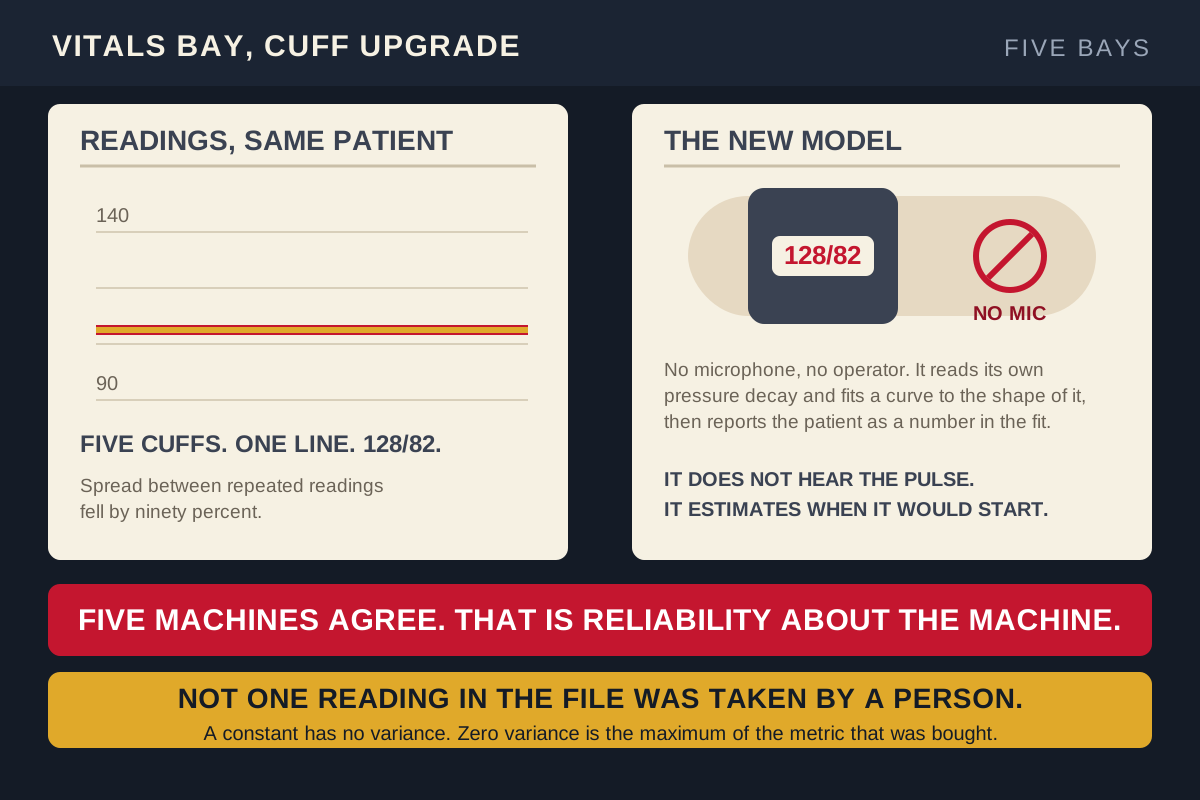
The clinic replaced its cuffs on the sixth, in all five bays, and the notice to staff is one line long. Repeated readings now agree to the last digit. The quality office calls it the largest single improvement in measurement the building has recorded, and this desk's first question is what the number is a measurement of.
The Old Cuffs Disagreed, Which Is What A Working Cuff Does
The old cuffs disagreed. Two operators on one patient differed by four millimetres of mercury. The two arms of the same patient differed by eight. The same patient, on the same arm, on two mornings, differed by five. The clinic's file treats those three spreads as one problem and this desk does not, because they are three different things. A blood pressure is not a property a cuff reads off a wall the way a thermometer reads a room. It is a quantity that moves with the patient, the arm, the cuff, the operator and the minute, and a spread between two readings is a record of all six of those being real.
The announcement does not distinguish between the three. It reports one figure, which is that the spread collapsed by ninety percent, and which of the six things that make a spread went away is the question the notice does not answer.
The New Cuff Estimates The Moment Instead Of Hearing It
The new model has no microphone and no operator. It inflates to a pressure it guesses from the last reading, then reads its own pressure decay as it vents and fits a curve to the shape of it. It does not hear the moment blood starts moving again. It infers that moment from the curve, and it reports the patient's blood pressure as one of the numbers that make the curve fit. The cuff is not measuring the patient against itself. It is measuring its own decay and expressing the result in millimetres of mercury.
Two identical decays produce two identical readings, and that is the whole of the improvement. The agreement is a property of the fit, and the fit is a property of the machine, so the five bays agree with each other for the same reason five identical calculators agree, which is that one vendor built them to run the same arithmetic on the same curve. That is a real property and this desk does not dispute it. It is not reliability about the patient. It is reliability about the instrument.
The Study The Clinic Bought Them On Is Not Wrong
The clinic bought the cuffs on a procurement study showing that variance between repeated readings fell by ninety percent against the previous model. This desk read the study. Its comparator is the old cuff. There is no arm in which a new cuff was checked against a person, and no arm in which any cuff was checked against a person, because the study's question was whether the new model agreed with itself, and that question can be answered entirely with machines.
The study is accurate and it says so. Variance between repeated readings is what you get when an instrument is noisy, and it is also what you get when an instrument stops responding, because a constant has no variance and no variance is the maximum of the metric that was bought. The clinic did not buy a measurement. It bought a number that does not move, and this desk would like to be able to say those are different purchases. It cannot, from this file.
"We have five instruments that give the same answer every time. That was the requirement, and it is met. I understood your next question when you asked it, and I do not have a version of the answer that is not a shrug, so I am giving you the file." The clinic's quality officer, by telephone, Wednesday
She sent the file without being asked twice and without redacting the part that does not help her, which is the reason this story is filed rather than dropped.
What The Desk Asked For, And The One Reading In The File
This desk asked for a reading taken by hand, on one bay, on the same day, on any patient, by any nurse. The file holds two hundred and forty comparisons between the new cuffs and the old model and no comparison between a cuff and a person. The clinic can say, with the study behind it, that its five cuffs agree with one another. It cannot say what they agree on, because the only instrument in the file that is not a copy of the instrument is a patient, and no patient appears in the file as a measurement. A person appears in the study as the thing the cuff was attached to, which is not the same as appearing in it as a reference.
There is one hand reading in the building. It is a nurse's, taken on the day of the install, on the cuff she keeps in her bag, and it disagrees with all five bays by eleven millimetres of mercury on the same patient in the same minute. The quality office has filed it as an equipment fault, on the ground that a reading that disagrees with five agreeing instruments is more likely to be wrong than all five are. That is a reasonable rule about instruments. It is also the exact rule the file was built to make unavailable.
Why The Agreement Is The Problem And Not The Fix
The clinic's hypertension protocol fires on a threshold, one hundred and forty over ninety. An instrument that reads a patient consistently low moves real patients below that line, and it does it reproducibly. Reproducibly is the word that matters, because a chart that shows a stable number is a chart that shows nothing to check. Five instruments that agree cannot tell each other that they are wrong. The old cuffs disagreed, and that disagreement was the last instrument in this building that was independent of the vendor, and the clinic retired it because it was working.
Desk note: this desk has asked for the same comparison before and been paid once. The September trial that reported an effect of four tenths of a millimetre of mercury in eleven thousand four hundred participants could certify a difference that small because every one of those participants was measured against a protocol by a person, and the person was the reference and not the object. The clinic's file would need one patient measured two ways to say anything at all about the five bays, and the desk is not going to get it here. What it has instead is a protocol that fires at one hundred and forty over ninety, a nurse with a cuff in her bag, and an office that has classified the only human reading in the building as a faulty instrument. This desk's position does not change with the size of the announcement. A measurement that cannot be checked against the thing it claims to measure is not a weak measurement. It is a strong measurement of something else, and the clinic has not yet said what.