This Desk Asked Both Passengers For The Ninety Seconds, One Of Them Has Deleted It, And The Surviving Clip Is The One That Agreed
Fifty seconds of overlap, one file, and a witness who remembers the other one agreeing. The protocol has a clause for disagreement and nothing can now go in it.
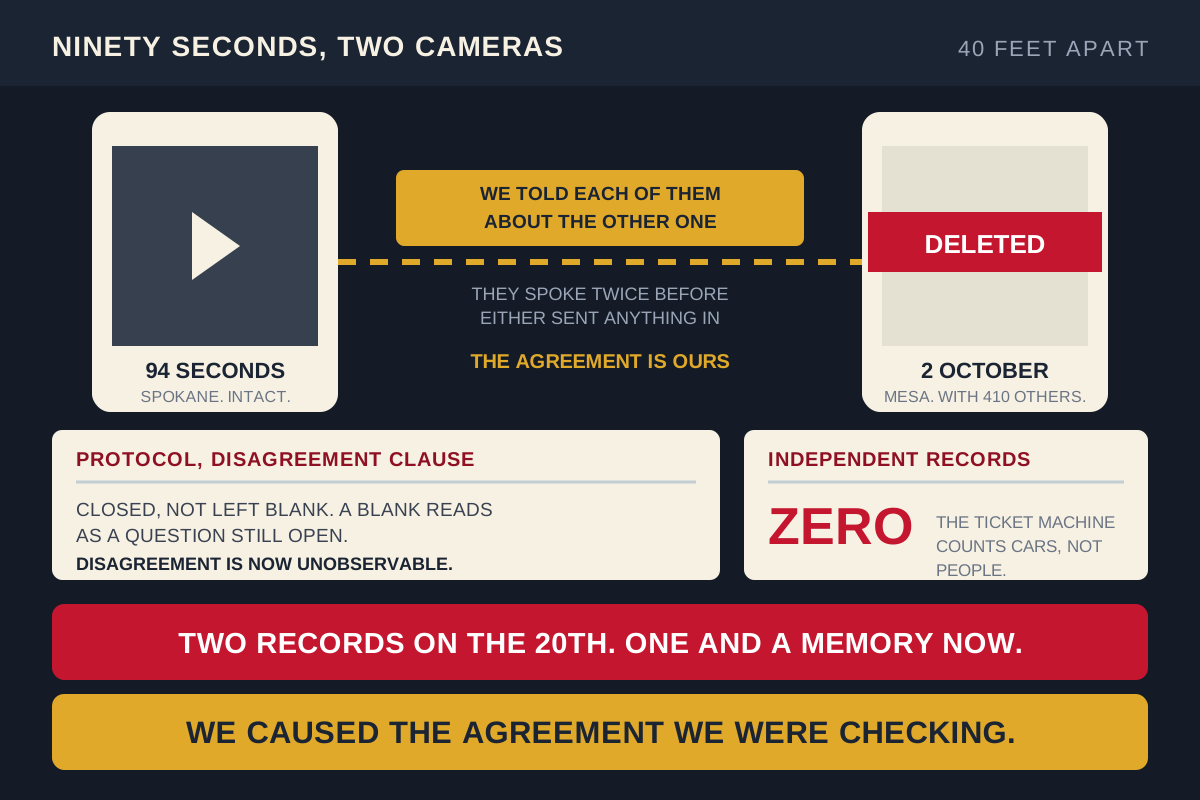
On the twentieth of September this desk published a protocol for two recordings of the same ninety seconds of concourse, written before either file was opened, which is the only reason a protocol is ever written first. The protocol said this desk would request both files, define the overlap, and report what the study could say if the two records disagreed. This desk requested both files on the twenty-second. One of them no longer exists.
The passenger who had it is a dental hygienist from Mesa and she has been completely straightforward about what happened. Her phone is set to remove videos older than thirty days when storage runs low. Storage ran low on the second of October, which is seventy-two days after the twenty-second of July, and the video went with four hundred and ten other things. She did not know this desk wanted it until the twenty-second of September, she did not back it up, and she has apologized three times, and this desk has told her three times that there is nothing to apologize for and will now tell her a fourth time in print.
The Survivor Is The One That Agreed
The file that survives belongs to the other passenger, a freight dispatcher from Spokane, and it is intact, it is ninety-four seconds long, and the fifty seconds of overlap this desk defined in the protocol are all present. This desk has now opened it, which under the protocol it was entitled to do, and it shows what the protocol anticipated it would show.
Here is the problem, and it took this desk six days to see it, which is six days longer than it should have taken. The reason this desk knows the two recordings agreed is that the two passengers told this desk so. They told this desk so in late September. They told this desk so because this desk had contacted both of them in the same week, mentioned to each that there was a second recording, and the two of them found each other, spoke on the telephone twice, and compared what they remembered before either of them sent anything in. The agreement between the two records was established by a conversation that this desk caused.
In September this desk published, correctly, that two cameras record and do not corroborate, and that the only variance a second camera introduces is the variance of cameras. That remains the finding. What this desk did not anticipate is the milder and more common failure sitting underneath it, which is that the moment a researcher tells two witnesses about each other, their independence is over, and no protocol written before the files were opened can protect a sample from the phone call that requests the files.
"She called me and we worked out we were about forty feet apart. We went through it. We had the same thing. I would not say we changed anything, but I would not swear to that either, and you are the one asking me to swear to things." The freight dispatcher from Spokane, October 5
The Disagreement Clause Can Never Be Filled
The reissued protocols carry a blank disagreement clause, which this desk added in September as the honest form of a question it could not answer. The clause records what the study will conclude if the two records conflict. It is now unfillable, and not because the answer is hard. It is unfillable because disagreement has become unobservable: there is one record, and one account of a record that no longer exists, given by a person who discussed it with the other witness first.
So this desk is closing the clause rather than leaving it blank, and the closing text is that the condition it was written for cannot arise in this study. That is a worse outcome than a filled clause and a better one than a blank that looks like diligence. A blank clause in a published protocol reads, to anybody skimming, as a question the desk is holding open. This one is not open. It is foreclosed, and the foreclosing event was a telephone call this desk placed.
Is Corroboration That Cannot Be Re-Run Corroboration
The question in the protocol was whether two records of the same type can corroborate each other, and the answer in September was no, they cannot, they can only concur. The question now is narrower and more awkward, which is whether a concurrence that cannot be re-examined is worth anything at all, and this desk's answer is no, and this desk would like to be specific about why, because the generous answer is available and this desk has watched three colleagues reach for it.
The generous answer is that two people with no connection to each other saw the same thing and said so, and that is evidence even if one file is gone. The reason it does not hold here is that every element of it failed in a different direction. They had no connection to each other until this desk connected them. The file is gone, so nobody can check the account against it, including her. And the account itself is of a video she watched in July and discussed in September, which is a memory of a recording and not a recording, and a memory of a recording is the weakest record type in this file and this desk has spent four years saying so about other people's work.
What this desk holds is one ninety-four second video from a fixed position forty feet from where the other one was, with fifty seconds of defined overlap against nothing, plus a witness statement attached to it. That is one record of one type with a note. It is publishable as exactly that and it is not publishable as two of anything, and the number of independent records this desk has over that afternoon is back to the number it was before July, which is zero, because the ticket machine counts vehicles.
Desk note: the number first. Ninety-four seconds held, fifty seconds of overlap now overlapping nothing, one witness statement, one deleted file, four hundred and ten other things deleted with it, zero independent records. The protocol stands as written and its disagreement clause is closed with a reason rather than left blank. The four candidate third records from September all still fail and all still fail for their original reasons, and the musician declining to be identified is still the one this desk thinks about. One procedural change goes into the reissued protocols as a result of this: when a study holds two records from two people, those people are not to be told about each other until both files are in hand, and if that cannot be arranged then the study holds one record and should say so on the first page rather than the ninth.