Annex C Is Being Read For The First Time In Fifteen Years, Three Ministries Have Quietly Stopped Publishing One, And A Fourth Has Published A Longer One Out Of Spite
The annex was free to publish for fifteen years because nothing turned on it. Three weeks of being read has cost two of the five ministries their annex and the concordance its third column.
On the fifteenth of September this desk published what five defence ministries put in Annex C, and the finding was that the chain of citations running through them was accurate at every link and terminated in a transcript paragraph that no minister had ever said aloud. This desk spent twenty-nine years not reading Annex C. Three weeks ago it read Annex C. This story is about what that did, and it is not the story this desk expected to be writing, because the thing it did was not political.
Annex C of a defence budget submission is the part that explains, in the registrar's own language and without a press officer's involvement, which figure was taken from where. It is long, it is dull, it carries paragraph numbers, and across the five ministries in this chain it had, by the estimate of the one registrar willing to be quoted on it, a combined readership in the single figures. That is what made it good. Nobody was performing in it because nobody was watching.
Three Ministries Have Stopped, And Not For The Reason You Would Guess
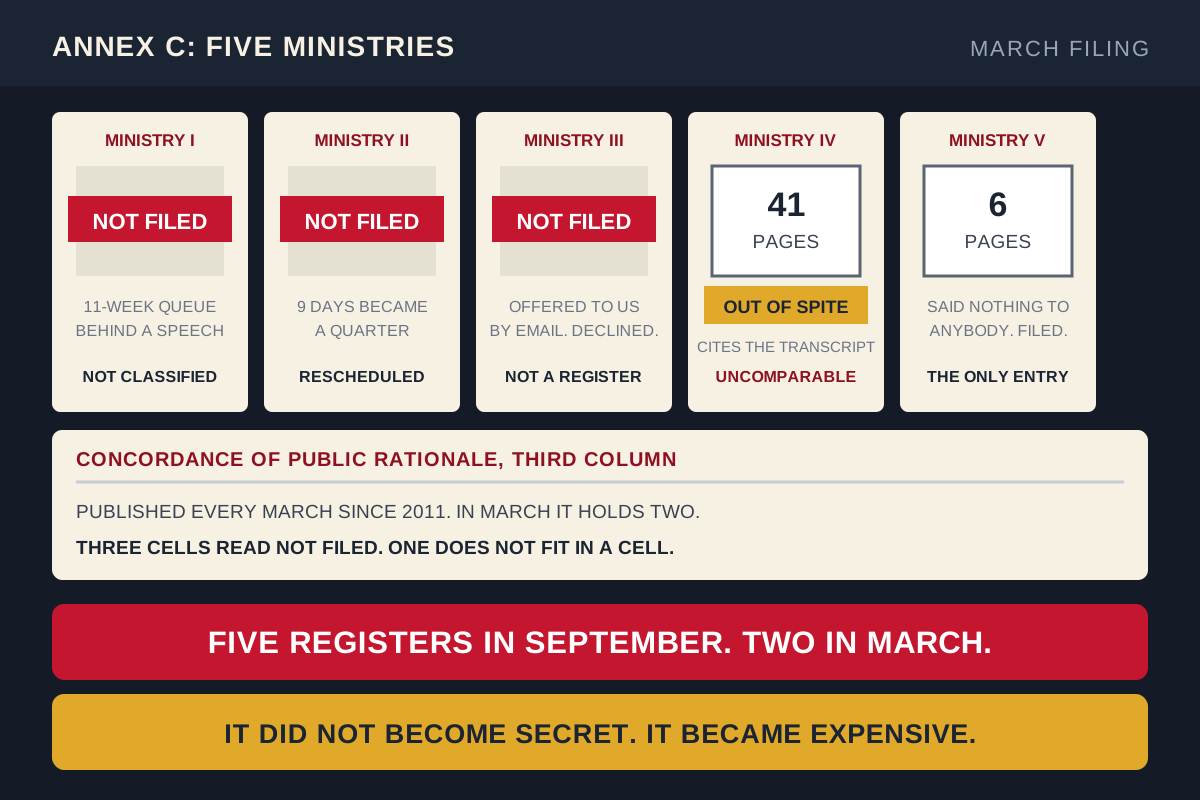
Three of the five have confirmed to this desk that their next submission will not carry an Annex C. None of the three gave secrecy as the reason and this desk pressed all three. The reason given, in three separate conversations, in three languages, was the same reason, and it is a cost: an annex that nobody reads can be written by a registrar in nine days and signed by a deputy, and an annex that is read has to go through the office that handles things that are read, which in two of the three ministries is the same office that clears ministerial speeches, and that office has a queue of eleven weeks.
So the annex has not been classified. It has been rescheduled, into a queue, behind a speech. One registrar put it more precisely than this desk could have: the document did not become sensitive, it became expensive, and the expense is other people's time. He has written fourteen of them. He said the fourteenth took nine days and the fifteenth, if there were one, would take a quarter, and that at that price it would be a different document whether or not anybody intended it to be.
"You are asking whether we are hiding it. We are not hiding it. We are declining to spend a quarter of a year on four pages that were worth four pages. If you want the annex back, stop reading it, and I am aware of how that sounds." A budget registrar at one of the three ministries, speaking on the record and declining to be named by ministry
The Fourth Ministry Has Published More, And It Is Worse
The fourth ministry, which is the one whose auditor explained at length in September why citing a neighbour's annex is a better source than citing the transcript, has gone the other way. Its submission landed on Tuesday with an Annex C of forty-one pages, up from six, and it is the best document of its kind this desk has read. It cites the transcript directly. It cites the paragraph number. It cites, in a footnote this desk has read four times, the fact that it is citing the transcript directly because a newspaper observed that nobody did, and it names the newspaper, which this desk would have preferred it did not.
It is also now the only forty-one page annex in a series of six-page annexes, which means it cannot be compared to its own previous editions, let alone to its neighbours. Its auditor is perfectly clear about this and considers it the other ministries' problem. This desk put it to him that he had broken a fifteen-year series. He said the series was broken in 2011 by being published in a form that could be compared only because all five parties were being equally uninformative, and that a comparison between five documents that all omit the same thing is a comparison of nothing.
He is right, and this desk would like to note how annoying that is, because it is the second time in three weeks that this particular auditor has been right about something he arrived at from a direction this desk considers indefensible.
The Concordance Cannot Be Built For 2027
The concordance of public rationale has been published every March since 2011. It is a five-column table and the third column is the one this desk cares about, because it is the column that records what each ministry's annex says the figure rests on. In March the third column will have two entries in it. Three ministries will file no annex. The fourth will file forty-one pages, which does not go in a cell. The fifth, which has said nothing to anybody and filed its annex last Thursday at six pages exactly as before, is now the only comparable entry in a table whose entire purpose was comparison.
The office that compiles the concordance has not announced anything. A person who works in it told this desk that the 2027 edition would be published on time, in the same format, with the empty cells marked not filed, and that this was the correct thing to do and would be read as an accusation against three ministries who had done nothing wrong. She asked whether this desk would be writing about it in March. This desk said yes. She said that was the problem.
What This Desk Did
The honest summary is that this desk found a genuinely transparent document, said so in print, and the document is now three-fifths gone and one-fifth unrecognizable. Nothing was concealed in response to the story. Nobody was reprimanded, nobody reclassified anything, and not one figure in any of the five submissions has changed. What changed is the cost of writing the thing down, and the cost went up because the thing was being read, and that is a cost this desk imposed.
This desk is not going to conclude that it should not have published, because the alternative is a newspaper that protects documents by ignoring them, and that is not journalism, it is curation. But the finding of the fifteenth was that these registers were honest because nobody was watching, and this desk printed that sentence, and then the sentence stopped being true in the manner the sentence described. The second colour on the office map, which marks the ministries that file an annex at all, is being redrawn for the first time since 2011, in the direction of the first colour, and the map is not revised for presentation.
Desk note: the terminal citation stands. The transcript paragraph is still the paragraph, it is still numbered, and not a minister anywhere along the chain has yet said it aloud, which was the finding of the fifteenth and is unaffected by any of this. Of the three ministries that are stopping, two have offered this desk the annex on request, informally, unpublished, by email, which is the arrangement a newspaper is always offered and is the opposite of a register. This desk has declined both, on the ground that a document given to one correspondent is not a published document, and has said so to both in writing, and both replied the same day saying they understood and that the offer stood.