Polling
Polling
The Worried Half Is Standing Inside The Confident Most
Most Voters Expect An Accurate Count And About Half Fear An Overturn. Laid One Over The Other, The Worried Half Is Standing Inside The Confident Most
By Marjorie Datapoint · October 23, 2026 · 4 min read
Marjorie Datapoint crosses confidence in the count with fear of an overturn, finds the fear requires the confidence, and discovers her anxiety series has been plotting a subset against its own superset since 2018.
Filed from the crosstab annex, both orders, same panel
A New York Times and Siena College poll published Friday found that most voters believe the midterm elections will be accurate, and that about half are concerned Republicans could try to overturn the results. Two numbers from one poll. This desk has fielded a version of each question in every federal cycle since 2018 and plots them as two lines on a chart called the Election Confidence Series. This piece is about the chart.
Read the way the desk has always read them, the numbers are two crowds: a confident majority and an anxious half. The series was built to watch the first fall and the second rise, and for four cycles it did. The October headline was drafted in September: confidence in the count falls for a fifth cycle. It did not. In this desk's own October reading the share expecting an accurate count was up four points on 2024. The desk checked it on a second coder and crossed it with the other number.
The Half Is Inside The Most
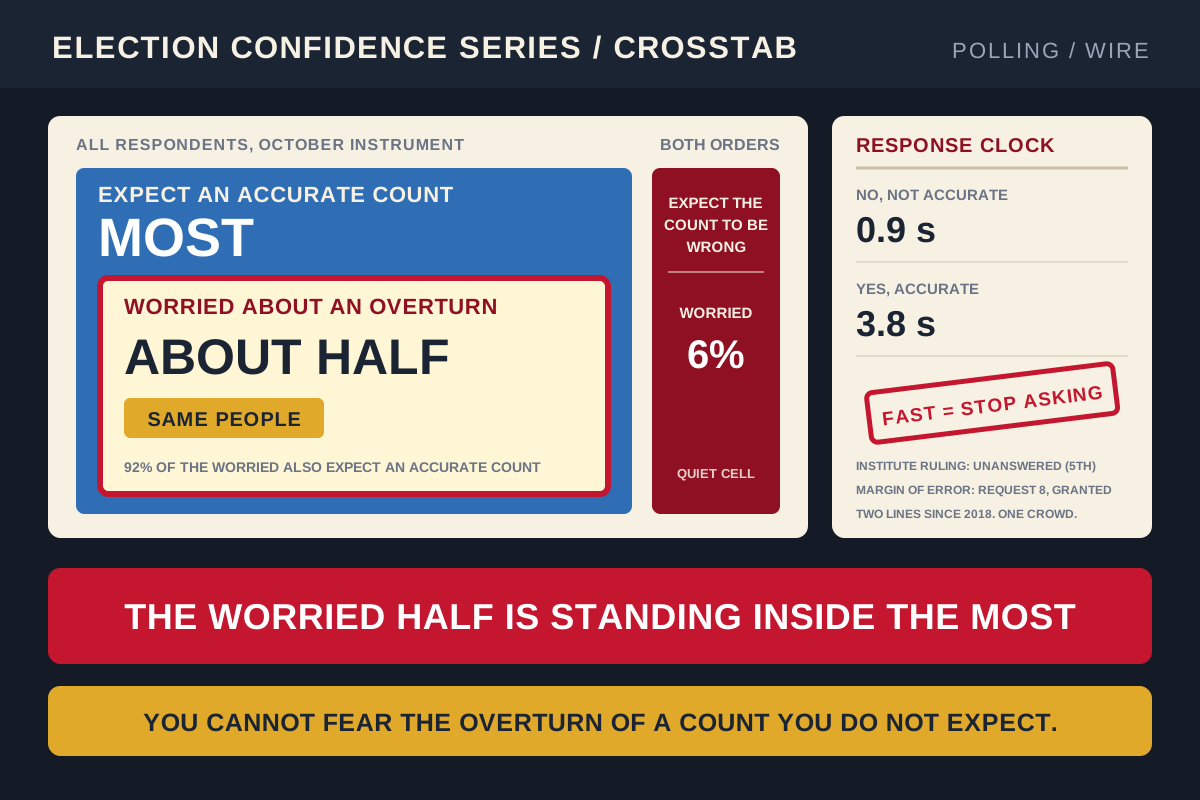
Crossed, the two crowds are one crowd. Of the respondents to this desk's instrument who were concerned about an overturn, 92 percent also expected the count to be accurate. Of the respondents who expected the count itself to be wrong, 6 percent were concerned about an overturn, which is the only quiet cell on the table.
The reason is not statistical. It is grammatical. To fear that a result will be overturned, a respondent has to expect there to be a result. Overturn is a verb that needs a correct answer underneath it to act on. Respondents who think the count will be wrong have nothing to overturn. Respondents who ticked the box have, by ticking it, told the desk what they think of the count. The worry is not a second measurement. It is the first measurement, holding a receipt.
"You asked people whether they trust the count, and then whether they are afraid somebody will throw the count out. The second question only makes sense to a person who said yes to the first. You have not found a nervous electorate. You have found a confident one that reads the news."
The remaining member of the desk's calibration panel, by telephone, Wednesday
Both Orders
The desk then ran the two questions in both orders on the same panel. Asked about the overturn first and the count second, the share expecting an accurate count rose three points. A respondent who has just said she is worried that a correct result might be thrown out has, one sentence later, to say whether she expects a correct result, and she does. The instrument does not talk people out of trust. It talks them into noticing they have it.
The clock agrees, and this desk did not want it to. The response-time file shows the fastest answers on the accuracy question are the noes: a median of 0.9 seconds, against 3.8 for the yeses. By this desk's September coding rule, a sub-second answer is a request to stop being asked. The desk coded the fast noes as requests, took them out, and watched the confidence number go up. A fast no is not distrust. It is a person declining to do the survey's arithmetic. A slow yes is a person who has done it.
The Series Was Measuring Trust Both Times
That leaves the chart. Rerun across four cycles with the crosstab it should have had in 2018, the worried line sits inside the confident line in every one of them. The anxious half was never a separate crowd rising while the confident crowd fell. It was the confident crowd, reporting what it was confident about and what it was afraid might be done to it, and the desk was plotting a subset against its own superset and calling the gap a mood.
The Institute of Applied Sentiment has ruled, unasked, that a fear predicated on a belief is to be scored as an endorsement of it, and that the series should be restated as one line. This desk notes the ruling, does not endorse it, and declines for the fifth consecutive time to answer it in the register the Institute recognizes. The ruling is not wrong. That is the difficulty with it. The Institute has now been right about a measurement it was not asked about, which article nine of its charter did not anticipate either.
Here is the reading, as a pair. Most voters expect an accurate count. About half fear it will be overturned. Laid one over the other, the half will not stand anywhere but inside the most. This desk set out to report that confidence in the count had fallen for a fifth cycle and found instead that the only people worried about the result are the ones who believe there will be one, which is a confident electorate by every coding rule in the annex, including the ones this desk wrote to get a different answer. The emotional reading is that the country is nervous the way a person holding a receipt is nervous. The statistical reading is that it has the receipt.
Desk note: The margin of error has filed its eighth request this year to be left out of this one, and the desk has honored it. The request arrived on Tuesday, before the two questions were crossed, which makes the margin the only party to this reading whose worry required believing nothing first.