Economy
Economy
Shoes Hit A Record High. Cost Per Step Hits A Record Low.
Shoe Prices Hit A Record High, And The Cost Per Step Hits A Record Low, Because Households Are Walking Further To Get Their Money Back
By Douglas Merritt · November 17, 2026 · 5 min read
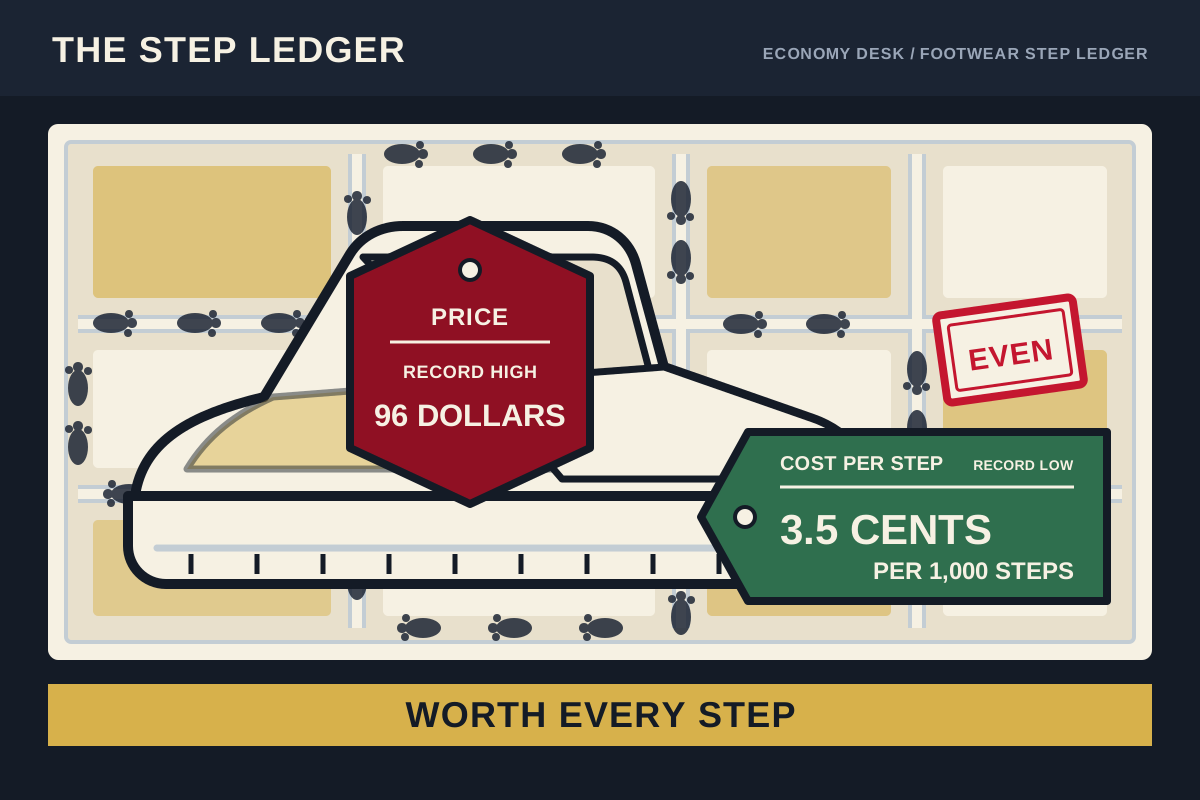
Douglas Merritt divides the record shoe price by the steps a pair now carries, logs the cheapest step the finance desk has ever recorded, and finds 47 households walking further to break even.
Filed from the Sunday spreadsheet, after the denominator was found
The price of a pair of shoes reached a record high in October, the New York Times reported Tuesday, as brands contend with the rising cost of materials and increased tariffs. That is a numerator. A price says what a household paid and nothing about what it got, and this desk has kept a file of what households got since March 2019. Douglas Merritt opened it Monday night and divided.
The file is the Footwear Step Ledger. It is not a government record and has no authority over a heel. It holds 223 pairs from 47 households, each logged at purchase and again at retirement, with a phone's step counter as the only witness. Eleven pairs have never been worn. Of the rest, 181 are retired and 31 were bought since last November and are still on somebody's foot. The ledger has two columns nobody has asked for, Price Paid and Steps Carried. The first made the news. The second turns the first into a rate.
The Price Went Up And The Step Went Down
The 181 retired pairs were bought between 2019 and last year at a median of $84 and carried for a median of 14 months. At the cohort's median 4,300 steps a day that is 1.83 million steps, or 4.6 cents per thousand. The 31 recent pairs cost a median $96 and are all still in service, so the ledger records the horizon each household gave at the counter: 19 months. Nineteen months at the same 4,300 steps is 2.48 million, or 3.9 cents per thousand. The price is up 14 percent. The step, on the households' own horizon, is down 16.
The recent cohort is not walking 4,300 steps a day. Its counters read 4,700. At 4,700, the same pair over the same 19 months carries 2.71 million steps at 3.5 cents per thousand, which is 23 percent below the earlier cohort and the cheapest step in the file.
"I paid ninety-six dollars for these. They are going around the block until we are even."
A household in the ledger, by telephone, who said the receipt was on the refrigerator
One household now walks its dog twice a day, up from once. The dog has not been consulted and is not in the file.
The Counters Are Busy
The desk then called 38 repair counters. Twenty-nine reported more resole jobs than a year ago, nine reported about the same and none reported fewer. The twenty-nine also reported a waiting list, which the ledger has no row for.
"People used to ask me how long a shoe lasts. Now they ask how long it can go on lasting. I tell them those are different questions and they say they know."
A cobbler in Toledo, by telephone, with a customer waiting
The Pair In The Closet
Eleven pairs in the ledger have never been worn. Steps carried is zero, so cost per step is a division the spreadsheet declines to perform, and it says so in its own error code, which the desk has left standing in the cell. It is the only entry in the file that is correct and cannot be quoted.
Anita Farnsworth reviewed the design and observed, cheerfully, that 47 households is a sample of 47, that the recent cohort is right-censored, which means every pair in it is still being worn, and that nothing in the ledger shows a tariff made anyone walk. It shows 47 households did. Diane Polk, shown the step counts, assessed the earlier cohort as unremarkable and the recent one, at 4,700, as ahead of the reference range, and asked what more was expected.
The Forecast In Row 1,318
The Sunday file holds this desk's own forecast at row 1,318, entered in June: that a household facing record footwear prices would buy fewer pairs and be worse off for it. The first half held. The second half is the delta in column E, the largest this year, and it runs in the shoe's favor. Federal Reserve Bank of Dallas Working Paper 23-09 remains this desk's reference for the narrower proposition that a price can move before the thing it prices is delivered. It does not concern footwear. The footwear has been delivered. The steps have not.
Douglas set out to document an affordability problem and has documented an amortization schedule. The record price is real and the record step is real, and they sit in different columns of a file that nobody asked for. This desk is not scoring the tariff. It is scoring the step. A reader who needs the two joined will find them joined in one place, on a sidewalk, going around the block.
Desk note: every figure for the recent cohort is a projection from a declared horizon and a logged step count, and this desk's record on projections is column E. The ledger carries an open row for the first of the 31 to reach its declared horizon, which falls in January. The cell is blank, not zero.