Health
Health
The Second Verb Is Admitted For Observation
Trump Announces 250 Million Dollars To Recruit And Retain Nursing Home Nurses. The Health Desk Admitted The Second Verb For Observation And Found No Prior Treatment On File
By Diane Polk · October 27, 2026 · 5 min read
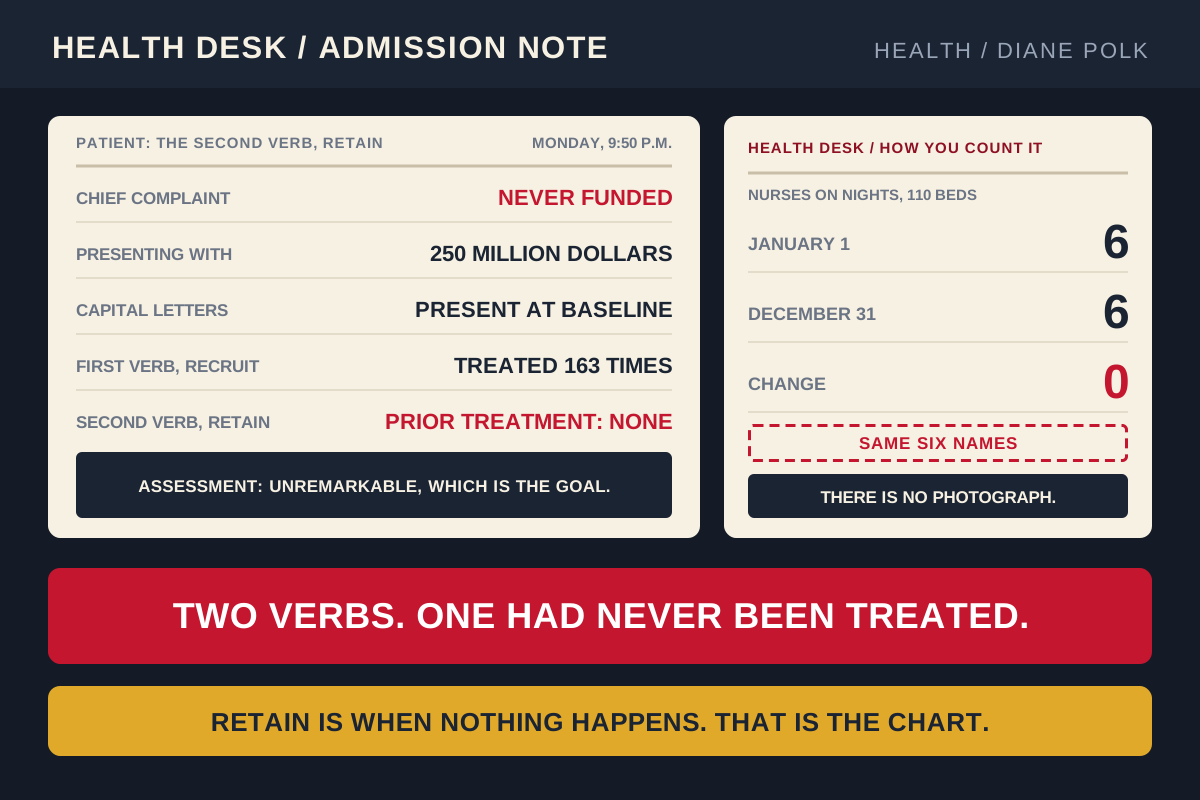
Diane Polk sets out to find which half of a two-verb sentence the money is for, learns that nobody has ever paid for the second half because its only output is nothing happening, and reports that nothing happening was the goal of every good shift she ever worked.
Filed from the Health desk, on the hours of a night shift this desk no longer works and still keeps
On Monday evening the President posted that his administration "is proud to announce a 250 MILLION DOLLAR PLUS initiative to RECRUIT and RETAIN Nurses for Nursing Homes!" This desk read it at 9:50 p.m., the way it reads a chart. Two verbs. One dollar figure. Capital letters on both. This desk admitted the second verb for observation.
I do not give opinions. I give assessments. You write down what is there, not what you hoped for. The capital letters are what everyone sees first, so I checked them first. They were present at baseline, unchanged, and not clinically significant. The verbs are.
History Of Present Illness
The condition is old. Nursing homes cannot keep nurses. I worked sixteen years in an emergency room, and a nursing home sent me a patient at three in the morning some four hundred times, with a note that said the same thing every time, in different handwriting: one nurse tonight, two floors. Nobody wrote that note because the home could not find a nurse. The home found one. She left. The note is about the second verb.
This desk keeps a file of staffing announcements. There are 163 in it, from 2011 to Monday night, and every one promises to recruit, hire or train. Forty-one also say retain. On Monday I sorted the file by which verb the money sits next to. Recruit, 163. Retain, zero. In all forty-one the second verb rides along on the first, the way a cough rides along on a cold. The money was for the arrival. It was never for the stay.
Why Nobody Pays For Nothing Happening
The reason is not a scandal. A recruited nurse is an event. She has a start date. You can count her the morning she walks in and photograph her in the lobby. A retained nurse is the absence of an event. She did not leave. There is no day on which she did not leave. There is every day. You cannot cut a ribbon on every day.
The best shift I ever worked, nothing happened. Nobody died, nobody coded, nobody came back. There is no form for that. There was a form and a budget for every shift where something went wrong, and never one for the shift where the thing that did not happen was the point. Medicine calls that prevention and funds it last, for the same reason the file has no dollars next to retain. The proof that it worked is a chart that says unremarkable.
"I can show you my recruiting. It is a folder. I cannot show you my retaining. I can show you Carla, who has worked nights here for nine years, and she will tell you she is still here because there is a second nurse on nights now. Nobody has ever asked me to put a number on Carla not leaving."
The director of nursing at a 110-bed facility outside Dayton, Ohio, who asked that the facility not be named and said it had asked her the same thing, by telephone, Monday night
How You Would Count It
This desk then did what the file has never done and worked out how you would count the second verb. You count the nurses on the floor. You come back in a year. You count them again. The number you want is the one that did not move. That is the entire output of a retention program, and a press office cannot photograph a number that did not change, because it looks exactly like nothing was done.
This desk wrote four weeks ago that a number which does not move is the first number to check, because a cuff that reads the same every time may have stopped measuring. It stands by that. You read the names. Five cuffs that agree have no names on them. A schedule with six on nights in January and six in December has names, and if they are the same six, the count held because the people stayed. A floor nurse reads those names every shift. Nobody has ever filmed it.
The Assessment
This desk expected to find the second verb riding along, as it does in the other forty-one. It is not riding along here. The sentence puts one dollar figure in front of both verbs and capital letters on both, and there is no third verb for the money to lean on. The first dollar in this desk's file attached to nothing happening arrived on Monday evening, in capital letters, and the capitals were present at baseline.
The editor asked what I think of the initiative. I think the patient has two verbs. One has been treated for as long as I have kept the file, and it is stable. The other was admitted for the first time on Monday night, and it is the one that was sending me patients at three in the morning. That is not an opinion. That is the chart. What did you want me to think?
Desk note: Anita Farnsworth asks it recorded, in message 142 of the chain, that a count which does not move is a null result and means nothing without a power calculation. This desk agrees with every word and has asked her what the sample is. The chain continues.