Culture
Culture
The Apple Was The Better Vault
Rare Pink Diamond Returns To Display After A Century, And The Museum Finds The Apple Was The Better Vault
By Simone Delacroix · October 18, 2026 · 5 min read
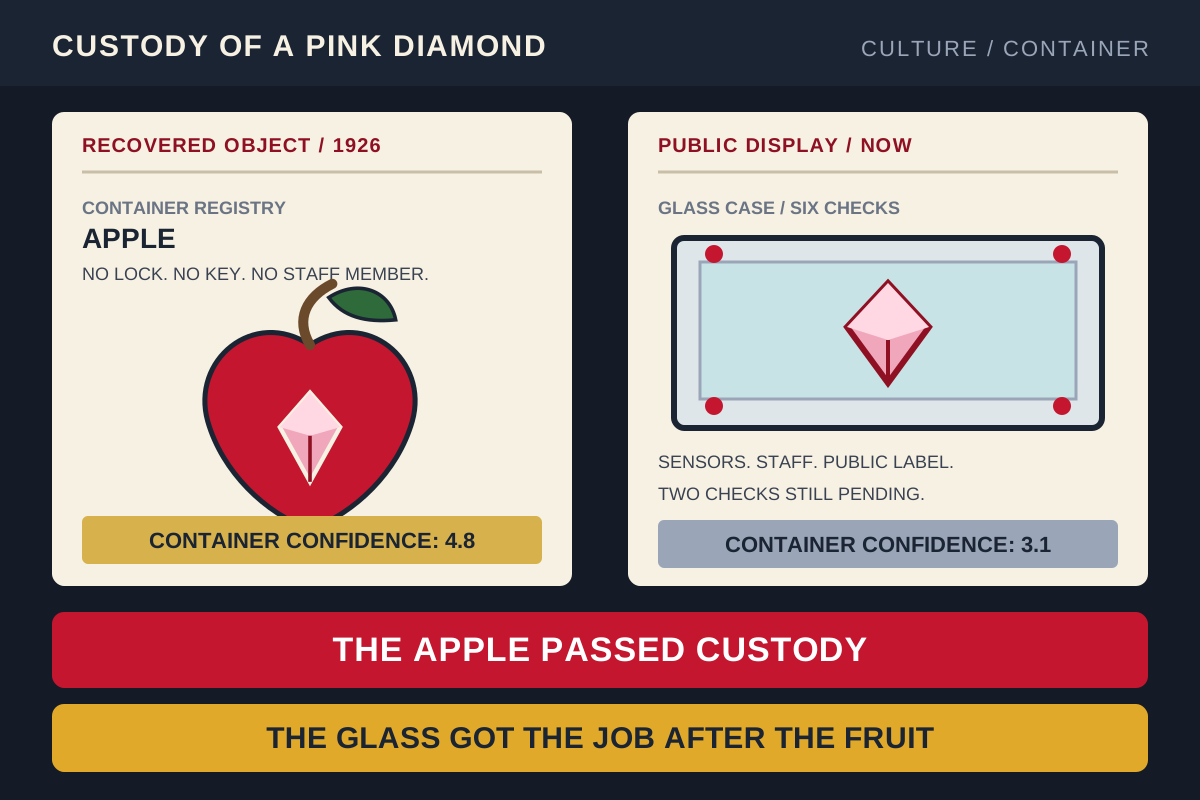
Simone Delacroix audits a pink diamond's century-long route from an amateur theft to a public display and finds the apple is the only container in the file that never asked to be trusted.
Filed from the culture desk, beside the fruit and jewel registers
A rare pink diamond is going on display in France 100 years after an amateur theft, after being found hidden in an apple following the 1926 theft. The culture desk went to the custody file expecting a jewel story. It found an apple with a cleaner record than the museum and a museum that has spent a century trying to improve on it.
The Apple Passed Intake
The Museum of Decorative Security keeps a Container Registry with fields for jewelry, evidence, produce and material not to be left near a sink. The apple entered under produce and stayed there. The diamond required a description, a weight, a color, a witness line and a person to certify that the witness line had not been filled by somebody who wanted a diamond.
"We have no evidence the apple knew what it was holding. That is the cleanest custody statement in the file. Every human involved had a theory."
Marta Pell, registrar at the Museum of Decorative Security, Sunday
That difference matters to security people. A vault is trusted because it is designed to be checked. The apple was trusted because it was not under discussion. A guard can inspect a case, a seal can be broken, a key can be logged and a photograph can be compared. Nobody inspected an apple for a diamond because the object was not yet the object they were looking for. The fruit did not defeat a security system. It avoided becoming one.
A Century Became Three Filing Periods
The recovered objects panel divided the century into Theft, Apple and Display, then discovered its form had only two rows. Theft required a date and an owner. Display required an address, an alarm and a person authorized to say the case was closed. Apple required a blank line. The blank line stayed blank until the object was found, when it became the most complete field in the file.
The desk asked whether a century inside the word apple could be called storage. The panel answered with the Container Confidence Index, which scores an object by the number of interventions it survives without requiring a new explanation. The apple scores 4.8. The glass case scores 3.1 because it has sensors, staff and a public opening but has not kept anything for 100 years.
"The apple did not have a lock, and it did not have a staff member with a key. It had an exterior that made the question seem rude. We have not reproduced that feature in glass."
Lydia Moreau, curator of recovered objects, in a written response
The Case Is Safer Because Everyone Is Looking
Once the display date was set, the museum fitted the case with sensors and a six-part inspection sheet. Four checks concern the glass, one concerns the alarm and one asks whether the container is edible. Two remain pending because no one can decide whether light falling on the stone is observation or exposure. The apple passed that question by having no sheet.
The desk's second test asked whether the apple would have passed the display protocol. It failed visible, labeled and insured. It passed occupied by fruit. The case passes the first three and fails only the historical measure, which is not a defect so much as a reminder that a new container cannot claim the record of an old one merely by being more expensive.
Simone set out to write about the romance of a jewel returning to public view and found a thread about institutions calling a thing secure after they have built a room around it. The diamond has not changed. Its social life has. The apple kept the stone because nobody knew which object required protection. The case keeps it because everyone now does.
The desk's conclusion is narrow. The diamond is ready for glass because the public can now be told where to look. The apple remains the only object in the custody file whose success did not require a certificate. This is not a defense of fruit. It is a finding about a container that did its job so quietly the museum had to invent a department to explain it.
Desk note: the culture desk has not counted the apple as a source. It was a container, and the distinction is the only reason the diamond reached the display form without a second theft.