Culture
A Museum Bought Forty Years Of This Restaurant's Menus, And The Curator Says The Collection Dates The Printer And Not The Food
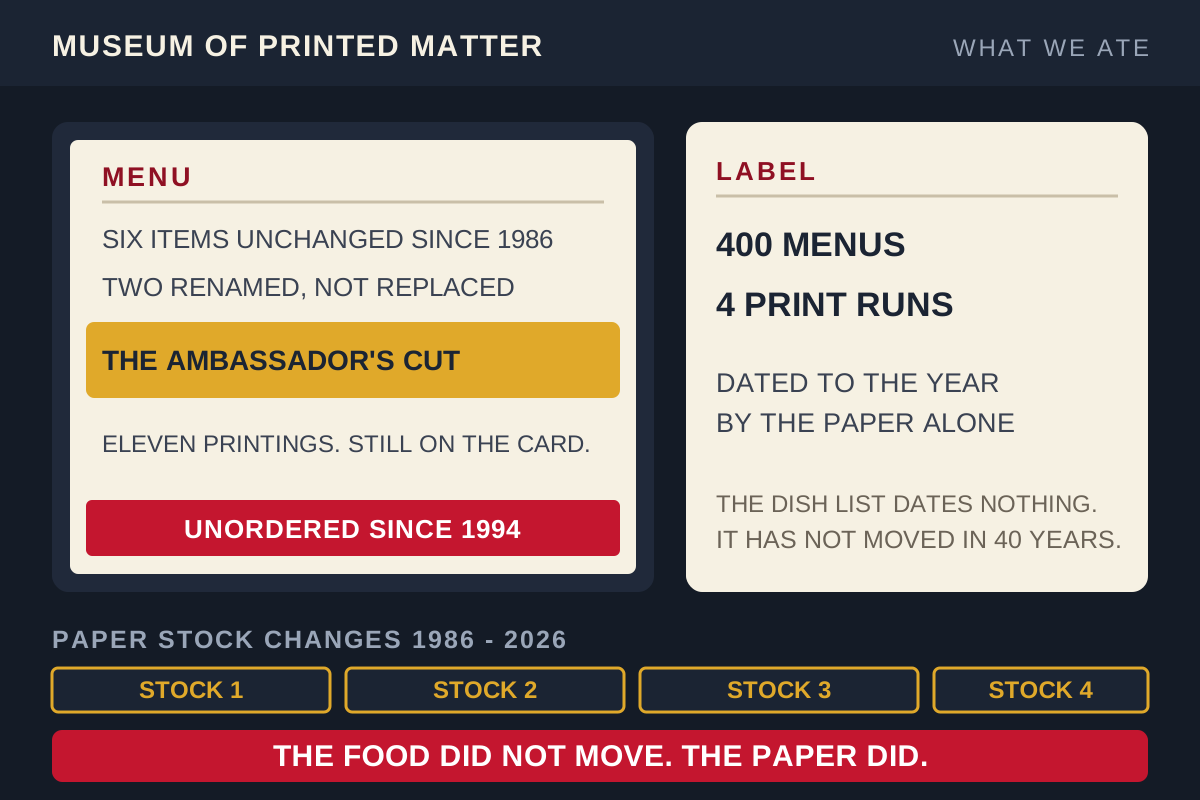
The dishes barely moved. The card changed four times, and the curator can put any of the four hundred menus inside a single year from the fibre alone. One item has gone unordered since 1994.
The archive occupies a converted print works on the north side, three rooms and a mezzanine, and the exhibit is called What We Ate: Forty Years At One Table. I went for the food. The first thing the curator said to me, in the doorway, before I had taken my coat off, is that the exhibit is not about food. She said it the way a person says a sentence she has said four hundred times, which is to say flatly, and with one hand already on the second door.
The table in question is a corner room with forty-one covers, two owners, one family, and a card that has been reprinted in roughly the same shape since 1986. Six of the eleven items on this week's menu are on a menu this archive holds from that year. Two have changed name and not content: the fish is the same fish with a different adjective. This is the part of the exhibit the posters lead with, and it is the part the curator discusses for the shortest amount of time.
What The Collection Can Actually Date
Four hundred menus, arranged chronologically behind glass, and she can place any one of them inside a single year. Not from the dishes. The dish list is far too stable to date anything. She dates the card. There were four stock changes in forty years and four inks across them, and the fibre of each card identifies the mill and the run, which identifies the printer, which identifies the year, because the printer was a shop in Hialeah that bought paper in annual lots, changed suppliers four times, and kept every invoice. The chronology in that room is the chronology of a print shop, fastened to a restaurant for the only reason chronologies ever fasten to anything, which is that the restaurant was the shop's most loyal customer.
"A menu is printed before the meal and it is never corrected afterwards. It is a plan. If you want a record of what a city ate, you need the plates that came back, and nobody keeps the plates that came back. What I have in this room is four hundred promises and a very good account of the paper they were made on." The curator of the collection, in the second room
The wall text in the first room does not say that. It says the collection documents what a city ate over four decades, and it is wrong, and the person who wrote it is standing in the second room explaining why it is wrong. She wrote it in 2019, when the collection was acquired, and has been correcting it in conversation ever since at a rate of roughly one visitor an afternoon, which is what the collection gets.
Present For A Reason That Is Not Food
Her index has sixty-one entries in it. Sixty-one items across these four hundred menus that are on a card for a reason which has nothing to do with eating, and her favourite of the sixty-one is on the current menu at the restaurant, where it has been since the printing of 1983.
The item is called the Ambassador's Cut. It has not been ordered since 1994, when a regular died, which is a coincidence and not a cause. It is still on the card because of a printing decision made forty-three years ago. The card is a four-panel sheet and the item sits in position six on the left panel, and the left panel was cut as one plate in 1983 with the item in it. Taking item six out means re-cutting the panel. A new plate costs the restaurant more than the item costs to keep, every year, and has for forty-three years, which means the item is now on the menu because of arithmetic that was done once and has been correct ever since.
The owner has told me twice that he is taking it off next printing. He has said that, so far, across eleven printings.
This is the ordinary condition of the collection and not an anecdote inside it. Sixty-one entries, and the reasons sort into a short list: a plate, a supplier contract, a dish somebody's mother ordered on the opening night, and one item that is on four different menus because four different kitchens each believe the other three are keeping it. The curator has given the index a heading of her own invention, items present for a reason that is not food, and it is now the largest single index in the building, which is a sentence about menus.
The Only Chart In The Building That Moves
The conservator's chart runs along the back wall of the third room: dishes per menu, plotted against the year. It is the only thing in the exhibit that moves, and the wall text presents it as a measure of ambition. It climbs through the early nineties, flattens, and falls off a ledge after 2008, and the label calls that the arc of a restaurant learning restraint.
The conservator, who is not the curator and does not share her patience, has overlaid the rent on the same axes. The rent was in the same lease file, which was in the same donation, which is why the overlay was available to anybody who opened the second folder. The menu grew in the years the rent was cheap and shrank in the years it was not, and the shrink happened within a fortnight of renewal every time but one. The single exception is 1997, when the menu grew in a year the lease did not move, and the conservator has left that year unannotated on the chart, which is the closest thing to mercy I found in three rooms.
Her objection to her own exhibit is that the horizontal axis is labelled dishes when it should be labelled presses. A menu's length is a printing decision before it is a culinary one. The card has four panels, a panel holds a fixed number of lines, and a kitchen that adds a dish must either take one off or pay for a fifth panel, which does not exist. The chart moves where the plate moves, and the plate moves when somebody at the printer has a quiet week.
The Last Room
The last room is the contemporary one. It holds the restaurant's current card in a case, and beside it, framed, a review of the restaurant that this publication printed in 2019, under the byline of the culture editor who held this desk before me. The curator bought it at auction in 2021 for forty-one dollars, a figure she volunteered before I asked, apparently on the view that a collection which stops at the moment of its own acquisition is a collection of furniture.
I objected, on the obvious grounds, that a review is not a menu. She agreed with me, and then made the argument I have been turning over since, which is that a menu is not a menu either. Both documents are written before the meal. Both describe an intention. Hers records what the kitchen meant to do and mine records what a person in the room wanted it to have been, and the archive's whole business, in her account, is the gap between those two and the plate that came back, which nobody keeps.
"You wrote yours from a table, on a Tuesday, with somebody bringing you things. I bought it because it is the only document in this building that records what a person hoped the food would be. I have four hundred menus and one wish. I am not going to throw the wish away." The curator, in the last room, on why the review is in the case
The exhibit runs to March. The Ambassador's Cut is still available. I ordered it, out of a professional obligation I would rather not examine, and it was fine. I have defended worse dishes at greater length in this publication and will do so again, on the standing principle that a preference is not a hierarchy and a menu is not a record of anything except the day somebody decided what to print. Jean-Pierre will write to me about it. He always does.
Culture note: the thread holds. Everything in that building which could be dated had been dated by its manufacture and not by its use - the menus by the card, the chart by the plate, the review by the archive that framed it, and, I am obliged to record, the reviewer by the review. The restaurant has stood on that corner for forty years and the only object in the exhibit which has aged on purpose is the one item nobody orders.