World
World
The Peace Registry Files The Partner Before The Peace
Trump Endorses Netanyahu For Reelection, And The Peace Registry Files The Partner Before The Peace
By Patricia Holloway · October 19, 2026 · 5 min read
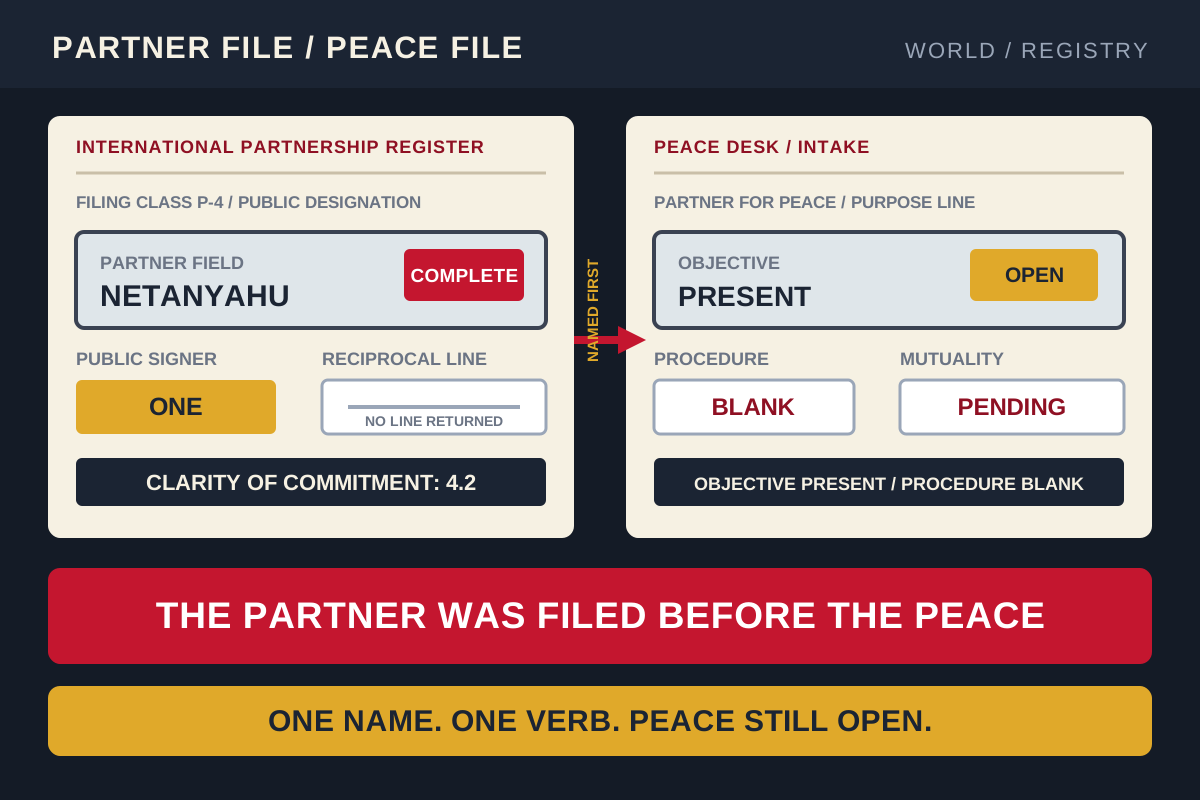
Patricia Holloway puts a reported endorsement through the International Partnership Register and finds that a partner can be named before the partnership is mutual.
Filed from the international desk, after the partner line was signed
NPR reported that President Donald Trump had endorsed Israeli Prime Minister Benjamin Netanyahu for reelection in a social media post, where Trump called him "a Great Warrior Prime Minister" and "an even greater Partner for Peace in combatting the Islamic Republic of Iran." Patricia Holloway went to the International Partnership Register to see what the partnership was required to carry.
The first surprise was not the endorsement. It was the form. The register has separate fields for partner, peace, mutuality, duration and what the registrar calls a reply from the other side. The partner box was open. The peace box was open. The partner box closed when the phrase Partner for Peace entered the file, while the peace box remained open on the ground that a phrase can name a relationship without establishing one.
The Partner Field Opens First
At 9:12 Monday, the registrar assigned the post to Filing Class P-4, Public Designation, and attached it to the partner field. The registry does not ask a designee to sign anything. It asks whether a public record has placed a named person in a role. The post did that. The form then produced a small red flag beside mutuality, not because the endorsement failed, but because nothing in the file required a second signature for this class. The flag is the registry's way of saying the entry is complete and the relationship is not.
"We used to make the two boxes depend on each other. That created an avoidable problem. A party could name a partner and then spend six months waiting for the partner to name the party back, during which time the first designation existed and the form pretended it did not. We now record the designation first and the reciprocity when it arrives."
Miriam Kedar, registrar of the International Partnership Register, Monday
Holloway asked whether the record was separating a partnership from the act of calling someone a partner. Kedar said it was useful once the noun stopped carrying the agreement.
Peace Is A Different Drawer
The peace desk has a harder test. It requires an objective, a prohibited method and a person authorized to say when the objective has been met. The phrase combatting the Islamic Republic of Iran supplies an objective-shaped line and nothing else. It does not say how the line is to be pursued, what counts as completion or whether a partner can be removed from the drawer after a disagreement. The desk marked the entry Objective Present, Procedure Blank, which is the most favorable result available to a sentence that was not written as a procedure.
"People keep bringing us a partner and asking us to certify peace. We can certify that a partner was named. We cannot certify that peace was delivered in the same envelope, because the envelope has a different slot."
Amira Tov, peace desk intake officer, Monday
The distinction would have remained clerical if the registry had not run its annual comparison. It placed the endorsement beside 22 bilateral agreements, 11 ceasefire declarations and seven friendship memoranda. Most had two signatures and no field describing what either side could do when the other side stopped being friendly. The endorsement had one public signer, no reciprocal line and a stated purpose that could be read without opening an annex. On the register's Clarity Of Commitment measure, it scored 4.2, above the agreements' median of 3.1. The score does not say the endorsement is a treaty. It says the registry can see what it is.
The Register Likes A Narrow Commitment
At noon, the panel added the status Narrow, Visible, Not Yet Mutual. That is not a new partnership class. It is a temporary tray for records that make one commitment clearly and leave the other commitments for later. The panel's chair said the endorsement did not promise a completed peace file. It named the person the United States was prepared to call its partner and named the reason in public. That was not the whole job. It was the part before the paperwork starts.
Holloway asked whether the better score reflected the endorsement or the registry's new preference for legible documents. Kedar said the register has no preference. It has only a field for a thing that can be read. The endorsement filled it in one line, which is why the panel did not have to infer what the partnership was supposed to be about.
By close, the peace box was still blank. The partner box was not. The registry had not converted an endorsement into peace, and it had not found a reciprocal line. It had made the smaller finding that the public record contained a partner designation with a stated purpose, and that the designation could be processed before the agreement it might someday describe. The conclusion is narrower than the headline and more useful than the registry's old rule: a partnership can be named before it is mutual, and a peace file can begin with a person who has been put in the right row.
Reporter's note: This correspondent has covered thirty years of agreements that arrived with three names and no usable verb. The register's smallest conclusion is that one name and one verb can still open a drawer.