Politics
Politics
Sworn Statements On The Arch Are Load-Bearing
Two Cabinet Secretaries Swore To A Court That A Triumphal Arch Is National Security. The Spine Desk Imaged The Statements And Found Load-Bearing Structure, Which Is What An Arch Is For
By June Hardaway · October 29, 2026 · 5 min read
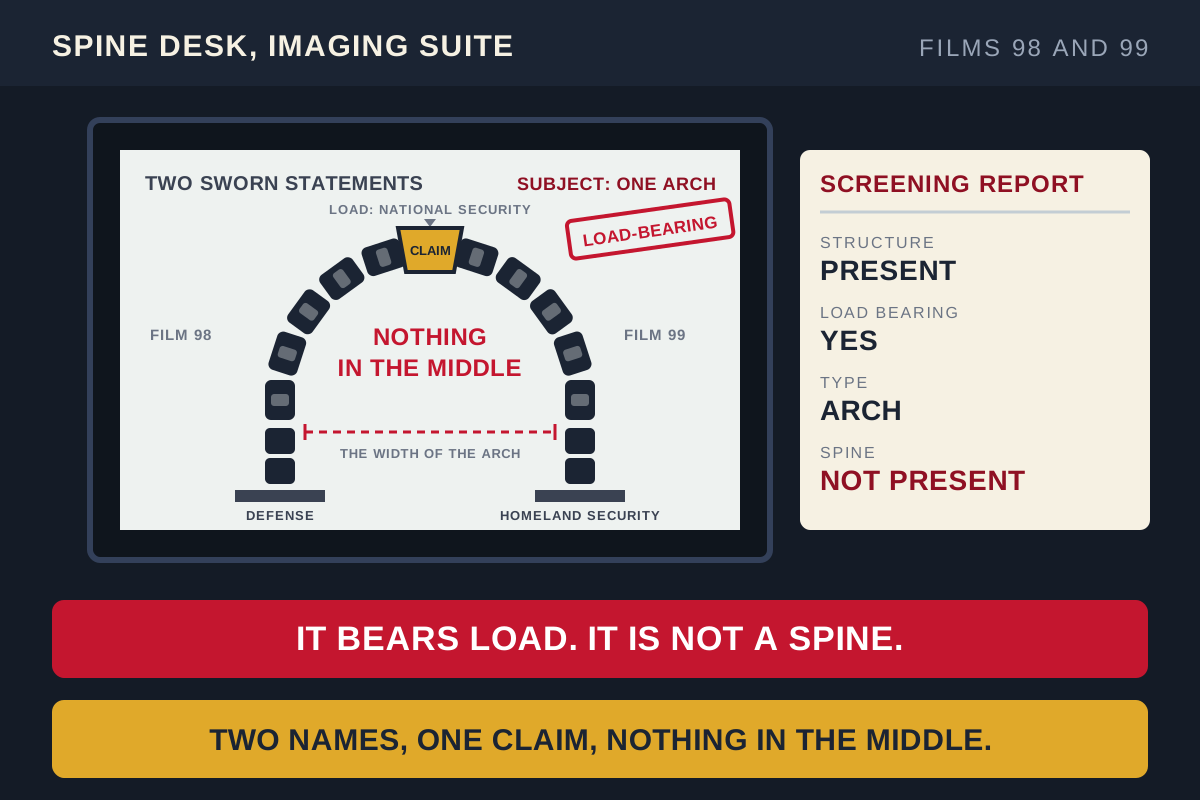
June Hardaway images two sworn statements about a triumphal arch, records the first load-bearing films a Cabinet has produced for her cabinet, and rules that a structure standing on two legs pressing toward each other is an arch and not a spine.
Filed from the imaging suite, films 98 and 99 on the lightbox
The Defense Secretary, Pete Hegseth, and the Homeland Security Secretary, Markwayne Mullin, have submitted sworn statements to a federal court backing the President's claim that a triumphal arch is needed for national security. That is the event, and it reached this desk as writing, signed. The first thing to report is that the equipment works. The desk checked the equipment first, against the phantom, a framed statement from 1954 that names names, and the phantom imaged completely, as it always has.
The Spine Desk screens courage by imaging the statements officials make, and its test is a load-bearing one: a statement carries a spine if it can support one proper noun without collapsing. It had not, before this week, been handed a statement made under oath. An oath is not a clinical category. It is a weight. A sworn statement has a cost attached to collapsing, and the instrument exists to find out what a statement does under weight.
What Was On The Film
The desk imaged the two statements separately, as films 98 and 99, and then together. Separately, each supports a proper noun, the arch, and a second, the name of the official who signed it, which the desk has spent two cycles failing to find beneath any statement. Together, the films show something new to this lightbox. The two columns do not stand upright. Each leans toward the other. They meet at the top under a single piece, the claim, and the claim is the President's. Below it, between the legs, there is nothing at all.
The desk measured the gap. It is the width of the arch.
"I have reviewed the films three times. There is bone on both sides, all the way down, bearing load, and no bone in the middle, and the structure is standing. In my previous career that is a patient I would have asked to lie back down. In this one the literature has a word for it, and the word is arch."
June Hardaway, imaging suite
Why It Bears Load
A spine is a column. It carries the weight above it straight down into the ground, one part on top of the next, and gives at the weakest part when the weight is too much. An arch takes a weight placed on its crown and sends it sideways, down both legs, into two separate footings, and each leg stays up only because the other is pushing back. Take one leg away and the other falls. A structural engineer the desk consulted called it the oldest load-bearing structure there is.
The two statements bear load. They carry the weight of a claim that is not theirs and pass it down into the Department of Defense and the Department of Homeland Security. Load has a direction: here it is applied from the top, by the claim, and carried the whole way down, by the names. The desk's stated goal since August has been a full cabinet, in both senses. These are the first two films from the second sense, and the names are at the bottom, carrying the weight, which is not where the desk expected them.
The Ruling
It is load-bearing. The desk rules that two sworn statements about the arch bear load, on the desk's own rule and no view of arches: the test asks whether a statement can hold a proper noun under weight without collapsing, and these hold two each, under oath, where collapsing costs the signer something no press release has ever carried. The desk has no instrument for whether a load is worth carrying. Diane Polk says medicine calls that a second opinion and that the desk would not enjoy one.
The desk declines to call it a spine. A spine stands on its own. This structure stands on two officials pressing toward each other under a third party's claim, and it holds up because of the part where nothing is, a defect in a spine and the design of an arch. On film they are identical until the weight comes off: a spine is still a spine, and an arch is two columns leaning on nothing. It is sound for as long as both halves stay where they are, which the desk notes, without comment, is also a description of the arch.
The desk set out to image two statements about a monument and expected soft tissue. What it found is the only pair of films in the cabinet with two names under a noun under oath, and they are holding up an arch. This bone arrived with a court date, and desk policy on late-arriving bone is unchanged: credit is issued regardless of origin. The reference cabinet now holds six films. Two of them are the same arch, and the desk cannot file a structure that needs both drawers.
Clinical note: films 98 and 99 will be filed together, because the desk tried filing them apart and one fell over. The national security correspondent has requested the documents and describes the wait as ordinary. Odell Marsh, shown the films at lunch, said that in his field a structure with two legs and nothing in the middle is a bird, and he would want to see it fly. The phantom was imaged again and showed a complete spine with nothing leaning on it. It has never needed a second film.